About Quercus douglasii Hook. & Arn.
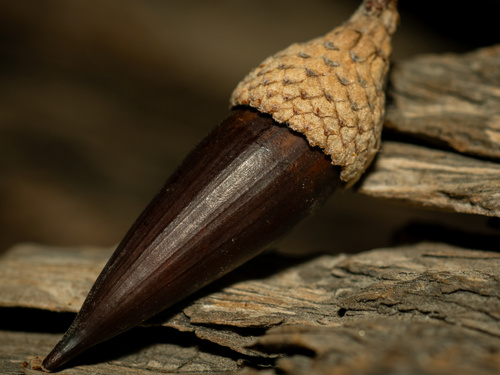
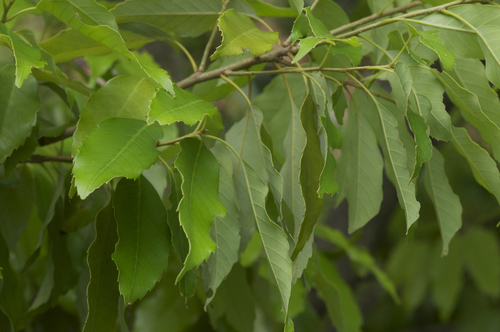
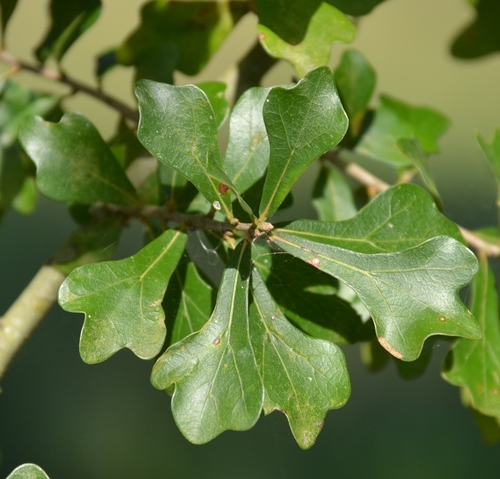
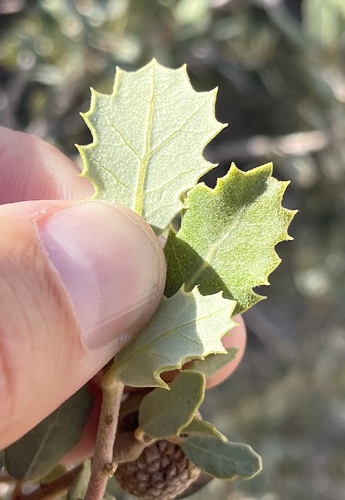
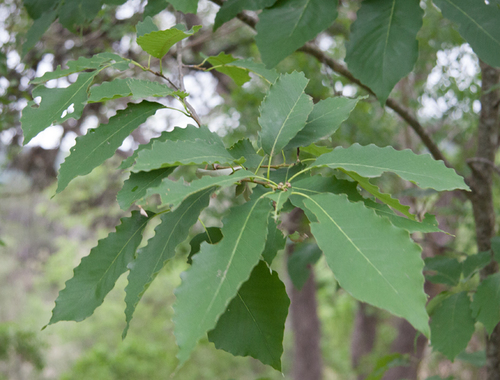
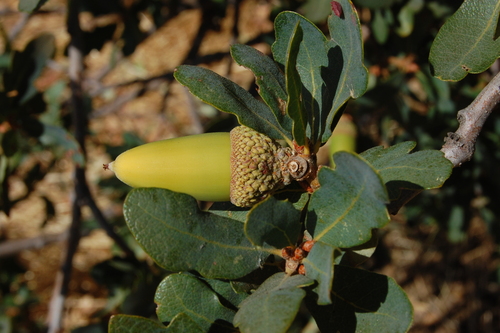
Quercus douglasii Hook. & Arn. is a medium-sized tree with sparse foliage. It usually grows between 6 and 20 meters (20 to 66 feet) tall, with a trunk diameter of 36 to 60 centimeters (1 to 2 feet) at breast height. Most trees have a single solitary trunk, though some grow multiple trunks. The tallest recorded specimen measured 28.7 m (94 ft) and was found in Alameda County. This species grows slowly, adding roughly 30 cm (12 in) of growth per year. Individual trees over 500 years old have been recorded. Its bark is light gray, marked by many medium-sized dark cracks. Its blue-green leaves are tough, leathery, and deciduous, reaching 4 to 10 cm (1+1⁄2 to 4 in) in length, with smooth entire margins or shallow lobes. Its acorns are 2 to 3 cm (3⁄4 to 1+1⁄4 in) long, have a moderately sweet kernel, and mature 6 to 7 months after pollination. Q. douglasii is monoecious and pollinated by wind. Flower buds require one full growing season to develop into catkins. Pollen from blue oak is severely allergenic. Q. douglasii prefers dry to moist soil and full sunlight. Its open sparse foliage lets more light reach the ground below, so young trees can grow for decades under the canopy of mature parent trees. This species often grows alongside gray pine (Pinus sabiniana), and also occurs alongside interior live oak (Q. wislizeni), coast live oak (Q. agrifolia), valley oak (Q. lobata), Oregon white oak (Q. garryana), and canyon live oak (Q. chrysolepis). Natural hybrids between Q. douglasii and the related species Q. lobata, Q. garryana, and shrub live oak (Q. turbinella) often form where these species grow in the same area. Sources recognize Quercus × alvordiana as a hybrid between Q. douglasii and either Q. turbinella or Q. john-tuckeri. Old-growth blue oak woodland may be one of the most widespread remaining old-growth forest ecosystems in California after European colonization. The acorns of Q. douglasii are eaten by wildlife and livestock. Q. douglasii acorns are edible for humans, but bitter acorns require leaching to remove tannins before consumption. Native Californians regularly gathered these acorns, which they considered good-tasting, and processed them into acorn flour. They also made baskets from blue oak seedlings, utensils such as bowls from the wood, and dye from the acorns. Commercially, blue oak is primarily used only for firewood.