About Quercus crispula Vuk.
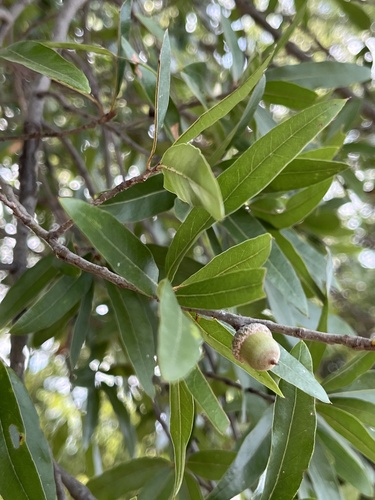
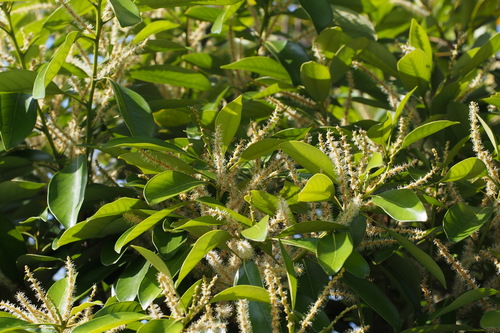
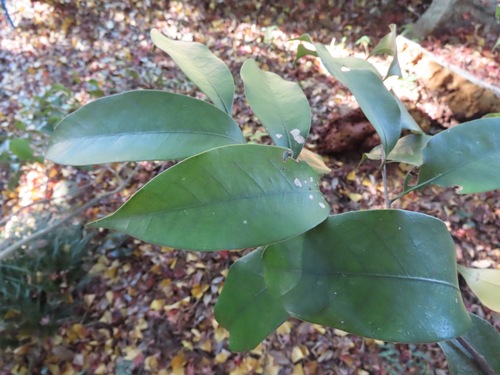
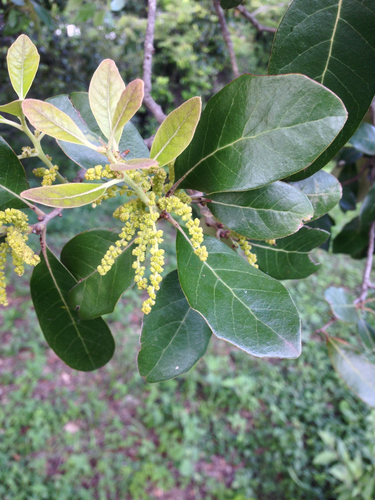
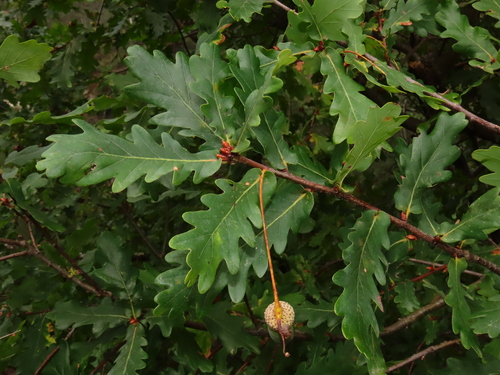
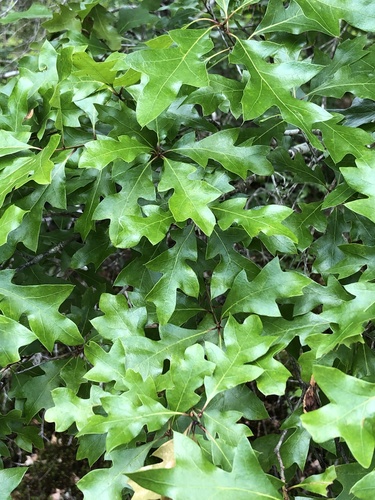
Quercus crispula Vuk. trees typically reach 9 to 18 meters (30 to 59 ft) in height, and may occasionally grow as tall as 27 meters (89 ft), with a canopy spread of 7.5 to 17 meters (25 to 56 ft). Tree trunks can reach up to 1.5 meters (4 ft 11 in) in diameter. Its leaves are dark green on the upper surface, lighter green on the lower surface, and glabrous. Leaves are tapered obovate to obovate-oblong, 10 to 20 centimeters (3.9 to 7.9 in) long, with 7 to 10 broad, coarse serrated teeth that are more wavy than the teeth on a typical oak. Flowers bloom from May to June; male flowers are yellow-green, female flowers are reddish, and inflorescences reach around 5 centimeters (2.0 in) in length. Acorns ripen in autumn, and abundant acorns are produced even when trees are still relatively young. Autumn foliage of Quercus crispula turns red or golden brown. Reported age ranges for the species vary: some sources note an average age of 368 years with a maximum recorded age of 772 years, while others cite a typical lifespan of 200 to 300 years. Compared to the continental species Quercus mongolica, Quercus crispula has a straighter trunk, and breaks dormancy later in spring, making it less vulnerable to damage from late frosts. It is winter hardy, which has made it a popular imported tree in Finland, and it grows in hardiness zones 5 to 8. Quercus crispula is wind-pollinated and monoecious.
Quercus crispula is native to all of Japan's main islands, as well as Sakhalin Island, the Kuril Islands, Amur, Khabarovsk, Korea, Manchuria, and Primorsky Krai. It is often found growing alongside Fagus crenata (Japanese beech) and Acer mono (Painted maple); all three act as canopy trees, with Fagus crenata being the dominant species. Within parts of its range, other deciduous trees commonly found with Quercus crispula include Fagus japonica, Magnolia obovata, Fraxinus lanuginosa, Acer japonicum, Quercus serrata, and Carpinus laxiflora. Quercus crispula prefers colder climates than the closely related Quercus serrata and Quercus acutissima. It grows naturally from low mountain areas up to the subalpine zone in Japan. Alongside beech, it is one of the dominant canopy tree species of deciduous broad-leaved forests in Japan, and prefers slightly brighter growing conditions than beech. Quercus dentata (Japanese Emperor Oak) cannot tolerate the extreme cold of northern Hokkaido, but Quercus crispula can. In the more southern parts of Hokkaido, Quercus dentata grows in coastal areas while Quercus crispula tends to grow more inland. In the northern parts of the island, the two interfertile species have undergone introgression, producing viable, reproductively capable shoots that have formed a coastal Quercus crispula ecotype with Quercus dentata-like traits. These coastal Quercus crispula individuals are intermediate between the two parent species in both genotype and phenotype. Studies have reached conflicting conclusions about whether Quercus crispula has only a single lineage that migrated north from southern Japan, or this southern lineage plus an additional lineage that migrated south from northern Hokkaido. Genetic studies confirm that after the Last Glacial Maximum (LGM), more than 20,000 years ago, the southern lineage only migrated as far north as the Oshima Peninsula, the southernmost tip of Hokkaido. The other lineage remained in central and northern Hokkaido, and admixture between the two lineages created multiple distinct lineages within Hokkaido.
Quercus crispula is generally not affected by serious insect or disease outbreaks, though it can be infested by leaf miners. Around 84% of Quercus crispula seedlings die within two years; most of these deaths occur in seedlings growing under or near the tree canopy, and are caused by herbivory from lepidopteran larvae. At least seven moth species in the genus Phyllonorycter feed on Quercus crispula: P. acutissimae, P. similis, P. cretata, P. pseudolautella, P. pygmaea, P. mongolicae, and P. matsudai. Other moth species that feed on Quercus crispula include Caloptilia mandschurica, Caloptilia sapporella, and Acronicta catocaloida. After insect defoliation, Quercus crispula regrows foliage faster than Fagus crenata. Like many other oaks, Quercus crispula exhibits masting behavior, meaning annual acorn production varies substantially from year to year. Historically, heavy masting occurred in alternating years, but this pattern became disrupted after 1995, apparently due to climate change. Masting synchrony occurs between all individual trees within a single stand. Weevils of the genus Curculio (including C. sikkimensis, C. dentipes, and C. distinguendus) infest 25 to 75 percent of mature acorns, disrupting the species' reproduction. These weevils have a prolonged diapause of two years or longer, and each species has its own distinct emergence timing, so they do not all emerge in the same year.
Quercus crispula grows best in rich, moist, well-drained loams (including sandy loams) located in full sun. It tolerates drought, clay soil, and dry soil well. It prefers soils with a slightly acidic, neutral, or slightly alkaline pH. It does not grow well in full shade, but can tolerate partial shade. Encouraging rapid growth does not generally improve wood quality, but long-rotation forestry practices do improve quality.
Outside Japan, Quercus crispula is most widely known for its use in barrels for aging Japanese and Scotch whisky. The wood is expensive, has high grain twist, contains fewer tyloses than other oaks, has poor watertightness, and has a high initial water content that requires a two-year drying period — all of these properties make it difficult for coopers to work with. The wood is also hard to source and commands high prices. Despite these drawbacks, Quercus crispula wood has earned international acclaim for imparting a delicate flavor and unique aroma to whisky that is completely different from the aroma and flavor imparted by other oak barrels. Whisky connoisseur David Broom described the aroma and taste as most reminiscent of aloeswood, similar to sandalwood, with hints of coconut, camphor mintiness, and cedar. The aroma of mizunara (Quercus crispula) wood is often linked to temples, and called "temple smell". This is because the wood contains some of the same molecules found in fungus-infected aloeswood from Aquilaria genus trees; aloeswood is commonly used to make temple incense, which explains the similarity in scent. Quercus crispula wood is also used to make some distillery washbacks. The most valued Quercus crispula trees for barrel making come from Hokkaido, where virgin forests of the species still remain. Hokkaido-grown oak trees are exported for whisky making due to the quality and flavor profile they impart. Hokkaido is well-suited for whisky production because of its long cold winters, warm summers, abundant peat, and large population of Quercus crispula.
In addition to whisky barrels, Quercus crispula wood is used to make high-end furniture and building materials. Hokkaido varieties of the species are particularly regarded for their good quality. Quercus crispula wood and chips also make an excellent growing medium for cultivating shiitake mushrooms. Extract made from the outer bark of Quercus crispula has demonstrated outstanding effectiveness against Toxoplasma gondii, a parasite that infects warm-blooded animals and causes toxoplasmosis. Three pentacyclic triterpenoids are responsible for this effect: 29-norlupane-3,20-dione, oleanolic acid acetate, and ursolic acid acetate. During the Jōmon period, tree nuts (including acorns, chestnuts, and horse chestnuts) were an important preserved winter food, especially in eastern Japan, and were stored in underground pits. The acorns of Quercus crispula contain astringent tannins and cannot be eaten raw, but become edible after processing to remove the tannins.