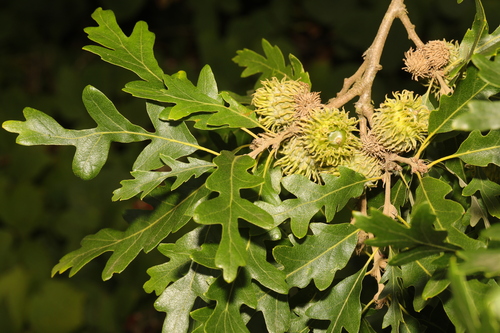
About Quercus cerris L.
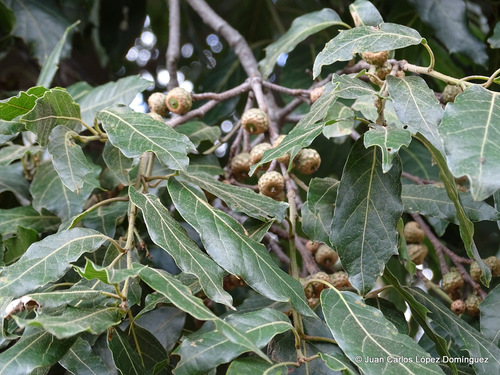
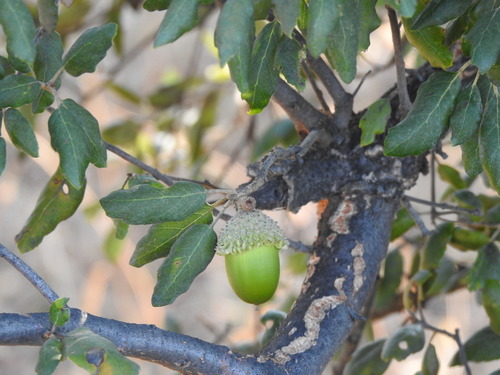
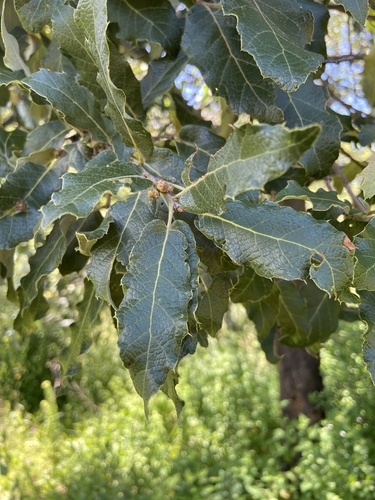
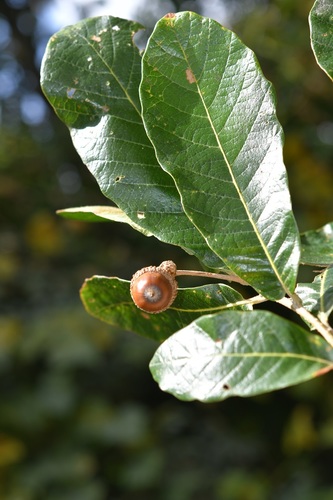
Quercus cerris L., commonly called Turkey oak, is a large deciduous tree that reaches 25–40 metres (82–131 feet) in height, with a trunk up to 2 m (6+1⁄2 ft) in diameter. Its bark is dark gray and deeply furrowed; on mature trees, the bark fissures are often streaked orange near the base of the trunk. The glossy leaves measure 7–14 centimetres (2+3⁄4–5+1⁄2 inches) long and 3–5 cm wide, and have 6–12 triangular lobes on each side. Lobing regularity varies greatly between individual trees, from very regular to highly irregular. Its flowers are wind-pollinated catkins, and the fruit (a large acorn) matures about 18 months after pollination. The acorn is 2.5–4 cm (1–1+1⁄2 in) long and 2 cm broad, and is bicoloured, with an orange basal half that grades to a green-brown tip. The acorn cup is 2 cm deep, and is densely covered in soft 'mossy' bristles that are 4–8 millimetres (1⁄8–3⁄8 in) in length. First-year acorns are very bitter. They are eaten by jays and pigeons, while squirrels usually only eat them when other food sources are exhausted. Before the most recent ice age, around 120,000 years ago, the species' native range extended to northern Europe and the British Isles. It was reintroduced to the UK and Ireland in the eighteenth century as an ornamental tree, and its associated gall wasps now provide early food for birds. This tree hosts the gall wasp Andricus quercuscalicis, whose larvae cause serious damage to the acorns of native British oaks. In 1998, the Ministry of Defence ordered the felling of all Turkey oaks on its United Kingdom bases. Turkey oak is widely planted and naturalized across much of Europe, partly due to its relatively fast growth. It is used as an ornamental tree and as a coastal windbreak. Several cultivars have been selected, including 'Variegata', a variegated cultivar, and 'Woden', which has large, deeply lobed leaves. Turkey oak readily hybridizes with cork oak (Quercus suber), and the resulting hybrid is named Quercus × crenata Lam. This hybrid occurs both naturally in the wild where the ranges of its parent species overlap, and has also been produced in cultivation. It is a very variable medium to large tree, usually semi-evergreen, sometimes nearly fully evergreen, and often shows marked hybrid vigour. Its bark is thick and fissured, but never as thick as the bark of the cork oak. Numerous cultivars of the hybrid are available, often grafted onto Turkey oak root stock. These include 'Ambrozyana', which is evergreen except in severe winters and originated from the Arboretum in Slovakia, the former home of the late Count Ambrozy; 'Diversifolia', which has extremely deeply cut leaves that leave only a narrow strip of leaf tissue down the centre of the blade, and very corky bark; 'Fulhamensis' (Fulham oak), raised at Osborne's nursery in Fulham around 1760; and 'Lucombeana' (Lucombe oak), raised by William Lucombe at his nursery in Exeter around 1762. An early specimen raised by Lucombe is held at the Royal Botanic Gardens, Kew. A similar Lucombe oak was felled by fungus and a light wind in Phear Park, Exmouth on 15 February 2009. The wood of Quercus cerris shares many characteristics with wood from other oak species, but it is very prone to cracking and splitting. Because of this flaw, it is only used for purposes such as fencing.