About Quercus bicolor Willd.
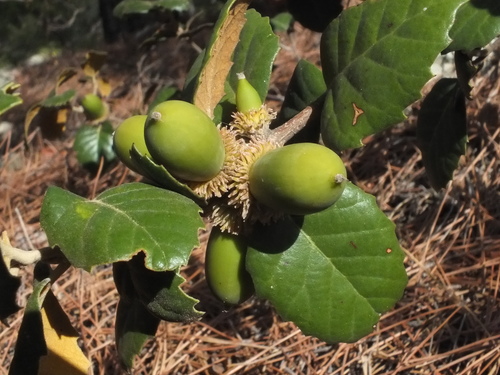
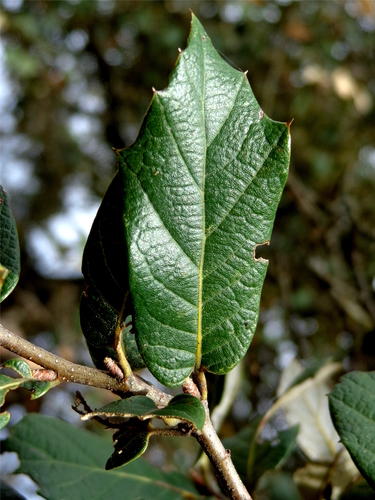
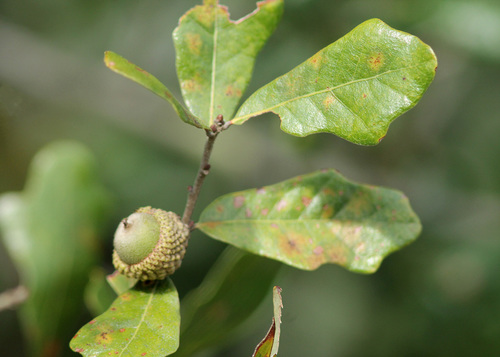
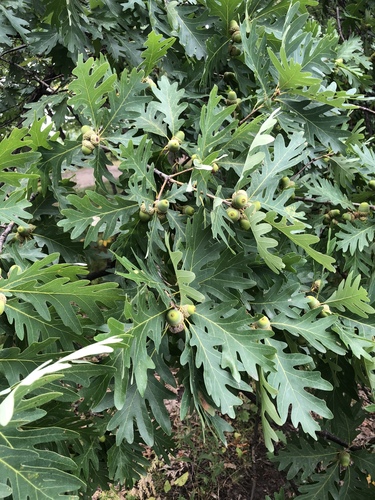
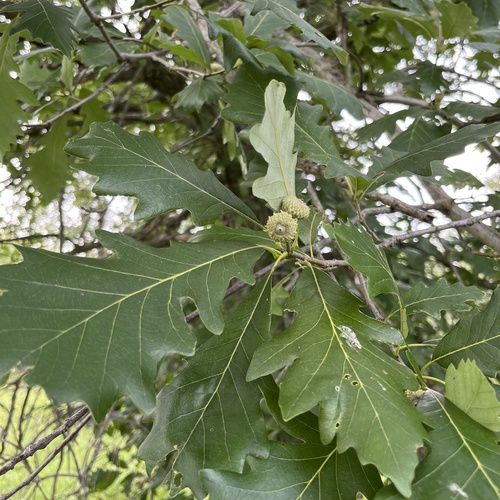
Quercus bicolor Willd. (swamp white oak) is a fast-growing tree that typically reaches 18 to 24 meters (60 to 80 feet) in height; the tallest known individual reaches 29 m (95 ft), and the species can live up to 300 years. Its bark resembles that of white oak (Quercus alba). Its leaves are broadly ovoid, measuring 12–18 centimetres (4+3⁄4–7 inches) long and 7–11 cm (2+3⁄4–4+1⁄4 in) broad. The underside of the leaves is always more or less glaucous, and the leaf margins are shallowly lobed with five to seven lobes per side, an intermediate form between chestnut oak and white oak. In autumn, leaves turn brown, yellow-brown, or sometimes reddish, but the fall color is generally less reliable and less brilliant than that of white oak. The fruit is a peduncled acorn, usually 1.5–2 cm (5⁄8–3⁄4 in) long (rarely reaching 2.5 cm / 1 in) and 1–2 cm (3⁄8–3⁄4 in) broad, that matures about six months after pollination. Good acorn crops occur every 3 to 5 years, with light crops in intervening years. The minimum seed-bearing age is 20 years, the optimum seed-bearing age is 75 to 200 years, and the maximum seed-bearing age is usually 300 years. Unlike many other oak species, swamp white oak seed is not dormant, so it germinates soon after falling to the ground. Seed collections must be made soon after ripening to delay early germination, and acorns are difficult to store without triggering premature germination or losing viability. Healthy, undamaged acorns have a germinative capacity of 78 to 98 percent. The primary agents that disperse swamp white oak acorns are gravity, rodents, and water. As a lowland tree, swamp white oak is distributed across eastern and central United States and eastern and central Canada, ranging from Maine to South Carolina, and west to Ontario, Minnesota, and Tennessee; there are also a few isolated populations in Nebraska and Alabama. This species is most common and reaches its largest size in western New York and northern Ohio. Swamp white oak generally grows as individual scattered trees in four distinct forest types: black ash–American elm–red maple, silver maple–American elm, bur oak, and pin oak–sweetgum. Occasionally, it forms small, locally abundant stands. It grows across a very wide range of mean annual temperatures, from 16 °C (61 °F) in the southern part of its range to 4 °C (39 °F) in the northern part, with extreme temperatures ranging from 41 °C (106 °F) to −34 °C (−29 °F). Average annual precipitation across its range is 640 to 1,270 millimetres (25 to 50 in). The length of the frost-free growing season ranges from 210 days in the southern portion of its growing range to 120 days in the northern portion. Swamp white oak typically grows on hydromorphic soils. It does not grow in areas with permanent flooding, but it is most often found in broad stream valleys, low-lying fields, and along the margins of lakes, ponds, or sloughs. It occupies roughly the same ecological niche as pin oak, which rarely lives longer than 100 years, but is far less abundant than pin oak. Swamp white oak wood is used for cabinets, boats, railroad crossties, fencing, and cooperage. It is one of the more important white oaks for commercial lumber production. Its wood is very similar to that of Quercus alba (white oak), and is not distinguished from Q. alba in the lumber trade. In recent years, swamp white oak has become a popular landscaping tree because it is relatively easy to transplant. It was the species selected for planting around the 911 Memorial Site in Manhattan. As a member of the white oak group, it attracts a range of wildlife including deer, bears, turkeys, ducks, and geese and other animals when acorns drop in the fall.