About Quercus berberidifolia Liebm.
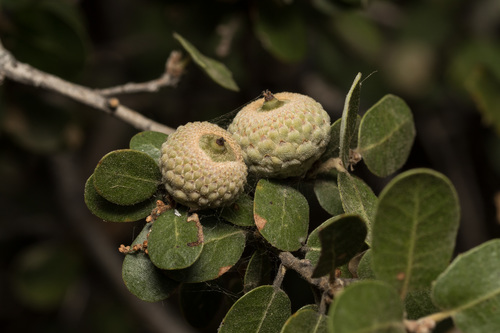
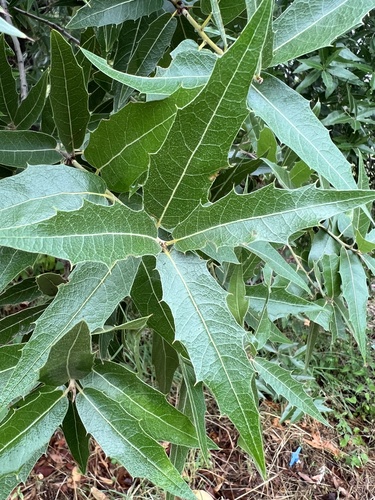
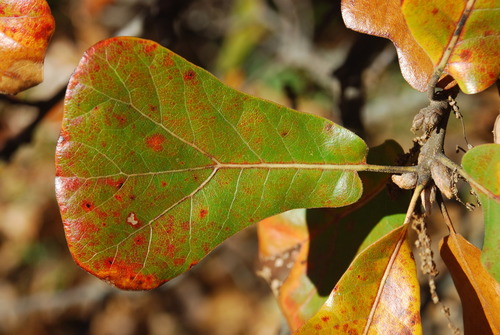
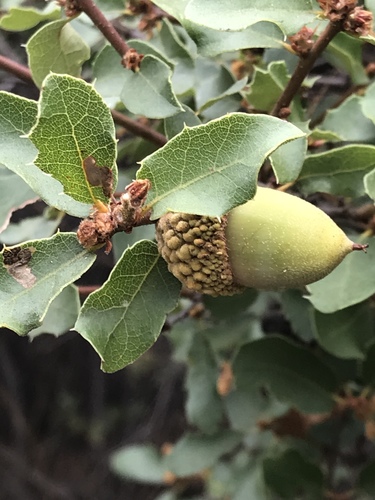
Quercus berberidifolia Liebm. typically grows 1 to 2 metres (3+1⁄2 to 6+1⁄2 ft) tall, and rarely reaches 4 m (13 ft). In cooler, more exposed areas, this scrub oak is usually a small, compact shrub, but in warm or sheltered locations it can spread out and grow several metres high. Its leaves are oval to egg-shaped, with sharp teeth, and a dull green color. They measure 1.4 to 3 centimetres (1⁄2 to 1+1⁄8 inches) long and 1 to 2 cm (1⁄2 to 1 in) broad. The upper leaf surface is leathery, while the underside is somewhat hairy. This species is monoecious, bearing separate male and female catkins on the same individual plant that bloom as new leaves unfurl. The leaf trichomes are minute, flat, and stellate, with 7 to 8 rays. Its acorns are brown, borne singly or in pairs, and are 1 to 3 cm (1⁄2 to 1 in) long and 1 to 2 cm (1⁄2 to 1 in) broad. Acorns have a barrel-like shape with a rounded or blunted tip, and mature 6 to 8 months after pollination.
Quercus berberidifolia is native to the U.S. state of California and the Mexican state of Baja California. It occurs from the foothills of the Sierra Nevada and California Coast Ranges south into northwestern Baja California, reaching its southern limit near Ensenada. It is one of the most common scrub oaks in central and southern California. It usually grows at mid-elevations from 100 to 1,800 m (330 to 5,910 ft) in chaparral and the margins of coastal sage scrub. In drier interior habitats, it is replaced by Quercus john-tuckeri in central California, and replaced by Quercus cornelius-mulleri south of the Transverse Ranges. South of Santa Barbara at low elevations near the coast, it is replaced by Quercus dumosa, for example in the fog belt of San Diego County.
In northern California, Quercus berberidifolia grows in mixed-chaparral communities, most often on mesic slopes. On the western slopes of the Sierra Nevada from Tehama County southward, it is an important to dominant component of chaparral. Associated species include chamise (Adenostoma fasciculatum), interior live oak (Quercus wislizeni), manzanita (Arctostaphylos spp.), ceanothus, toyon (Heteromeles arbutifolia), yerba santa (Eriodictyon californicum), and California buckeye (Aesculus californica). In the North Coast Ranges, it co-dominates mixed-chaparral communities with chamise. This oak also grows in the understory of woodlands, and is typically associated with blue oak (Quercus douglasii) woodlands. It occurs occasionally in riparian communities in the Central Valley.
In southern California, Quercus berberidifolia dominates some scrub oak, mixed, and maritime chaparral types, with chamise, ceanothus, and manzanita as co-dominant species. Except for maritime chaparral, these communities usually grow on north-facing slopes. In the San Bernardino Mountains, it dominates low elevation slopes, and grows in mixed stands with other species at higher elevations. In the Tehachapi Mountains, the most common chaparral type is Ceanothus cuneatus and Quercus berberidifolia chaparral, which occurs at low elevations in discontinuous strips. It is also found in southern California woodland habitats, including the understory of Tecate cypress (Hesperocyparis forbesii) stands in San Diego County. It also occurs in some pine woodland communities, such as those in the San Bernardino, Santa Ana, and Cuyamaca mountains.
The acorns of Quercus berberidifolia are edible.