About Quercus aucheri Jaub. & Spach
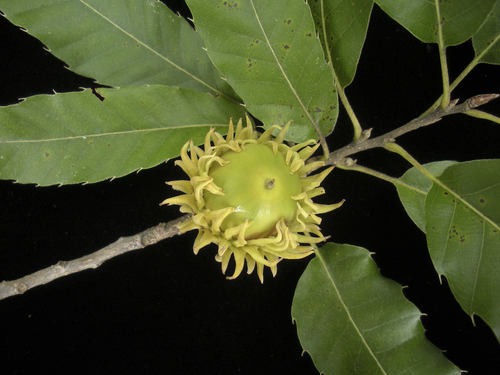
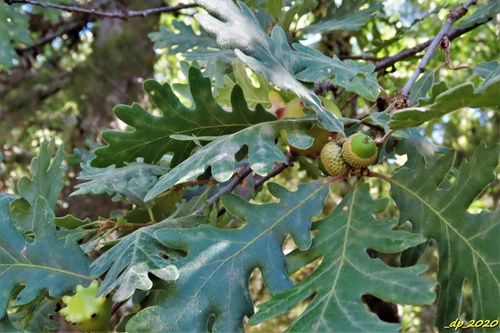
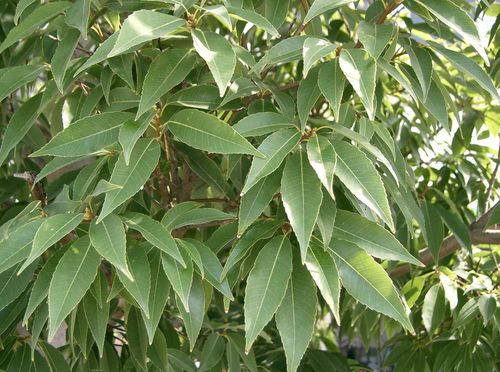
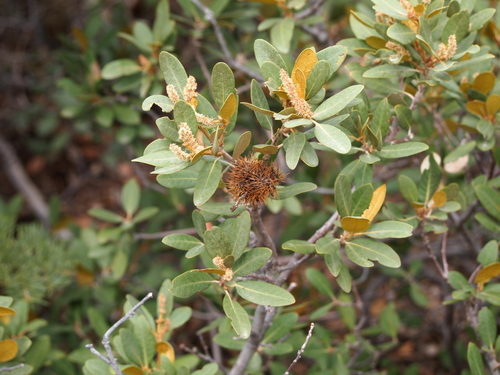
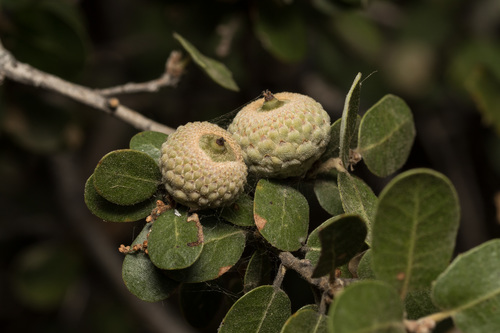
Quercus aucheri Jaub. & Spach grows as a small evergreen tree or shrub, reaching a maximum height of 10 meters. It is closely related to kermes oak (Quercus coccifera) and is not always distinguished from that species; it also bears a strong resemblance to other species in the Mediterranean holly oak group. Unlike kermes oak, Quercus aucheri produces sweet acorns rather than bitter ones, and its acorns germinate from the base instead of the tip. Additional distinguishing traits include short petioles, and acorns that are hairy, sometimes appearing white from their hair covering. The undersides of Quercus aucheri leaves are hairy, while kermes oak leaf undersides are not. Leaf morphology in this species is highly variable, with both entire and serrated leaf margins found on the same individual tree. The species was first formally described by Hippolyte Jaubert and Édouard Spach in 1843, and its species epithet honors Pierre Aucher-Éloy. Quercus aucheri is definitively placed in Quercus section Ilex, but its closest relative within the section remains unclear. A molecular analysis has suggested it is most closely related to holm oak (Quercus ilex), while a comprehensive phylogenetic analysis by Hipp et al., plus morphological comparisons, place it closer to kermes oak. Other researchers have argued it is more closely related to the western Mediterranean ballota oak (Quercus rotundifolia), based on shared similarities in leaf and acorn morphology. The natural distribution of Quercus aucheri is restricted to the islands of Rhodes, Kos and nearby islands in the south-eastern Aegean Sea, plus the south-western coast of Anatolia, where it occurs mainly in the provinces of Muğla, Antalya and Aydın. Despite its small overall range, it is a common component of coastal woodlands in the southeastern Aegean and the Teke Peninsula, growing on volcanic and calcareous slopes. It occurs in more coastal, lower elevation sites than kermes oak, though the two species have overlapping ranges. It also co-occurs with Aleppo oak (Quercus infectoria). Other common species in these woodland communities include Turkish pine (Pinus brutia), Mediterranean cypress (Cupressus sempervirens), wild olive (Olea oleaster), Phillyrea, and other shrubs. The sweet acorns of Quercus aucheri are edible, and local people have used them as a coffee replacement. The acorns also have medicinal value. The species' overall population is currently stable, and it is classified as Least Concern (LC) by both the IUCN and the Red List of Oaks. However, its restricted coastal distribution means that ongoing coastal development poses a potential threat to the species.