About Quercus acutissima Carruth.
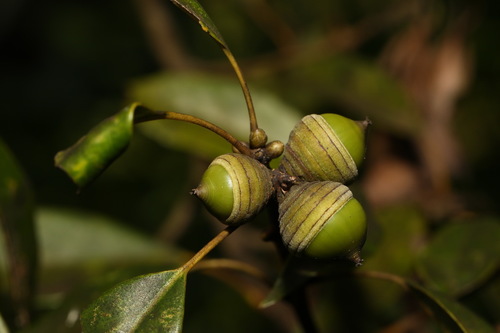
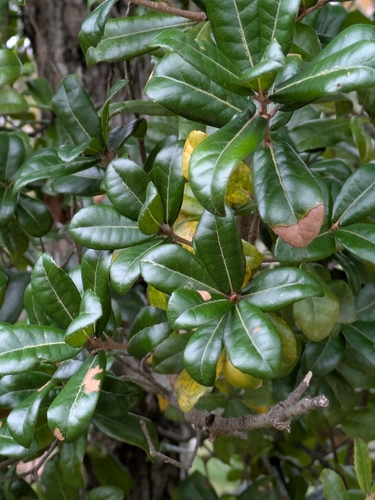
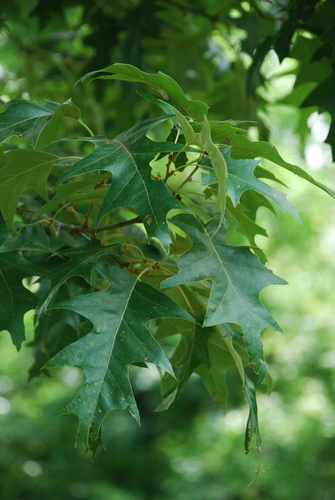
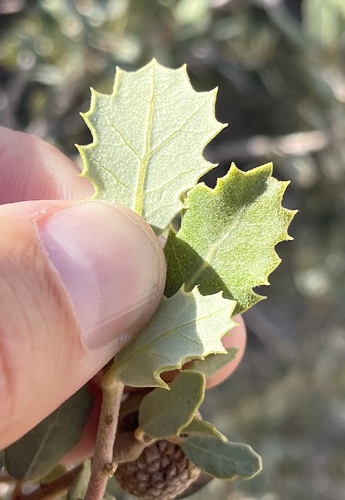
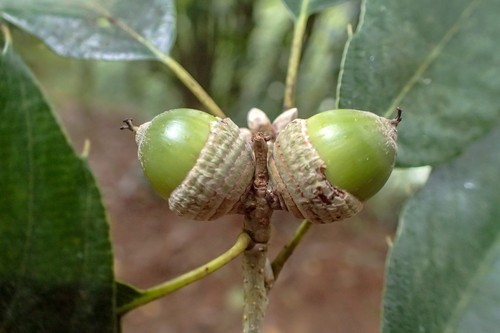
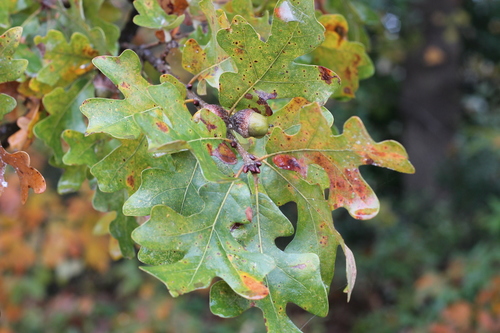
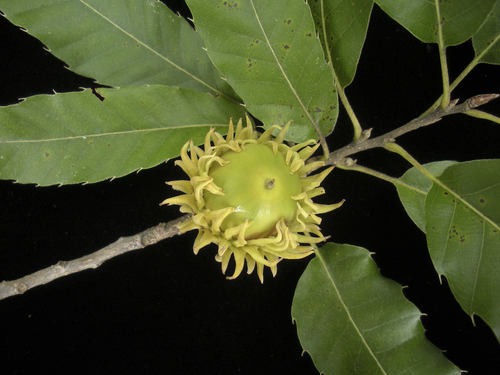
Quercus acutissima Carruth. is a medium-sized deciduous tree that reaches 25–30 meters (82–98 feet) in height, with a trunk up to 1.5 meters (5 feet) in diameter. Its bark is dark gray and deeply furrowed. Leaves measure 8–20 centimeters (3+1⁄4–7+3⁄4 inches) long and 3–6 centimeters (1+1⁄4–2+1⁄4 inches) wide, with 14–20 small, regular, saw-tooth-like triangular lobes along each edge. It produces wind-pollinated catkin flowers. Its fruit is an acorn that matures roughly 18 months after pollination; the acorn is 2–3 centimeters (3⁄4–1+1⁄4 inches) long and 2 centimeters broad, and is bicolored, with an orange basal half that fades to a green-brown tip. The acorn cap is 1.5–2 centimeters (5⁄8–3⁄4 inches) deep, and densely covered in soft, 4–8 millimeter (3⁄16–5⁄16 inch) long "mossy" bristles. This species is closely related to Quercus cerris, and both are classified in Quercus sect. Cerris, a section of the Quercus genus defined by shoot buds surrounded by soft bristles, bristle-tipped leaf lobes, and acorns that mature in approximately 18 months.
In its ecology, Quercus acutissima acorns are very bitter. Jays and pigeons eat these acorns, while squirrels typically only consume them when no other food sources are available. Sap can leak from the tree's trunk, and beetles, stag beetles, butterflies, and Vespa mandarinia gather to feed on this sap. The species is native to Asia. It was introduced to the United States around the 1920s, and has become established in the eastern United States, including in states such as Florida, Missouri, New York, Alabama, and Pennsylvania. It prefers well-drained acid soils, which allows it to thrive in a variety of harsh locations. Because of its fast growth, people often plant its saplings without considering potential harm to local native species. This tree can outcompete native species, which may damage local ecosystems. To reduce the potential negative impacts of sawtooth oak, researchers recommend removing tree saplings and removing the species entirely from reclamation species lists.
Sawtooth oak is widely planted in eastern North America and is naturalized in scattered locations there. It is also occasionally planted in Europe, but has not naturalized on that continent. Most historical planting in North America was done to provide food for wildlife, as the species produces heavier acorn crops than native North American oak species. However, the bitterness of the acorns makes it less suitable for this purpose, and sawtooth oak is now a problematic invasive species in some areas and states, such as Louisiana. Its faster growth rate further helps it outcompete native trees. Its wood shares many characteristics with other oaks, but is very prone to cracking and splitting, so it is only used for purposes like fencing. Charcoal produced from this wood is used specifically in braziers to heat water for the Japanese tea ceremony.