About Quelea quelea (Linnaeus, 1758)
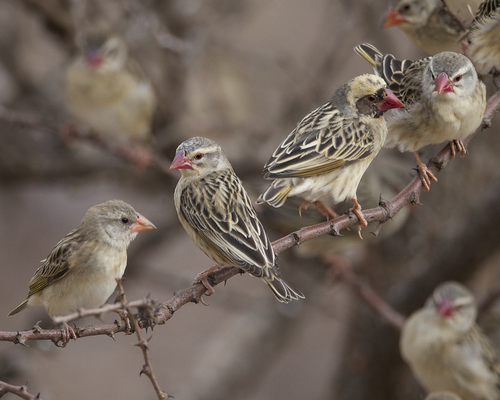
The red-billed quelea, scientifically named Quelea quelea (Linnaeus, 1758), is a small sparrow-like bird. It measures approximately 12 cm (4.7 in) long and weighs 15–26 g (0.53–0.92 oz), with a heavy, cone-shaped bill. The bill is red for males and for females outside the breeding season, and orange to yellow for females during the breeding season.
Over 75% of males have a black facial "mask" that covers the black forehead, cheeks, lores, and upper throat. Occasionally, males have a white mask instead. The mask is surrounded by a variable band of yellow, rusty, pink, or purple; white masks are sometimes bordered by black. The mask colouring may only reach the lower throat or extend along the belly, and the rest of the underparts are light brown or whitish with some dark stripes. The upperparts have longitudinal stripes of light and dark brown, especially at midlength, and the rump is paler. The tail and upper wing are dark brown, and the flight feathers are edged greenish or yellow. The eye has a narrow naked red ring and a brown iris, the legs are orangey, and the bill is bright raspberry red.
Outside the breeding season, males lose their bright colouring: they have a grey-brown head with dark streaks, a whitish chin and throat, and a faint light stripe above the eyes. At this time, the bill becomes pink or dull red, and the legs turn flesh-coloured. Females resemble non-breeding males in plumage, but during the breeding season they have a yellow or orangey bill and eye-ring. At other times, the female bill is pink or dull red.
Newborn red-billed queleas have white bills and are almost naked, with only small wisps of down on the top of the head and shoulders. Their eyes open on the fourth day, when the first feathers also appear. Older nestlings have a horn-coloured bill with a faint lavender tint, which turns orange-purple before the post-juvenile moult. Young birds moult for the first time two to three months after hatching; after this moult, their plumage resembles that of non-breeding adults, though their head is grey, cheeks are whitish, and wing coverts and flight feathers have buff margins. By around five months of age, they moult again, and their plumage begins to match that of breeding adults, with a pinkish-purple bill.
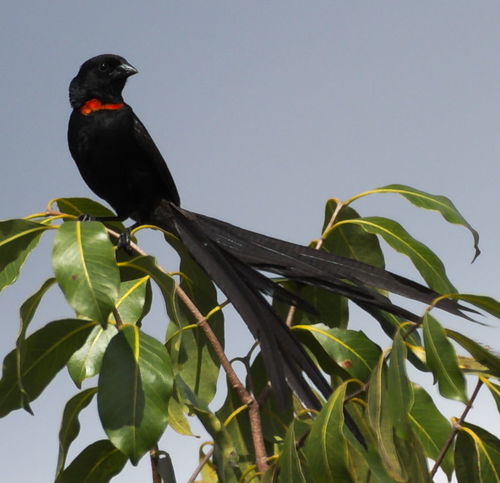
Different subspecies are distinguished by differences in the colour pattern of male breeding plumage. In the nominate subspecies Q. quelea quelea, breeding males have buff crown, nape, and underparts, and the black mask extends high up the forehead. In Q. quelea lathamii, the mask also extends high up the forehead, but the underparts are mainly white. In Q. quelea aethiopica, the mask does not extend far above the bill, and the underparts may have a pink wash. There is extensive colour variability within each subspecies, so some individual birds cannot be assigned to a subspecies based on outward appearance alone. Interbreeding produces intermediate specimens where subspecies ranges overlap, for example at Lake Chad. Non-breeding red-billed queleas can be confused with female pin-tailed whydahs, as both are sparrow-like birds with conical red bills; the whydah can be told apart by its whitish brow that sits between a black stripe through the eye and a black stripe above the eye.
The red-billed quelea occurs mostly in tropical and subtropical areas with a seasonal semi-arid climate, which support dry thornbush grassland including the Sahel. Its distribution covers most of sub-Saharan Africa. It avoids forests, including miombo woodlands and the rainforests of central Africa, and is generally absent from western South Africa and the arid coastal regions of Namibia and Angola. It was introduced to the island of Réunion in 2000. While it can occasionally be found as high as 3,000 m (9,800 ft) above sea level, it mostly lives below 1,500 m (4,900 ft). It visits agricultural areas to feed on cereal crops, though it is thought to prefer seeds from wild annual grasses. It needs to drink daily, so it is only found within approximately 30 km (19 mi) of the nearest body of water. It occurs in wet habitats, and congregates at the shores of waterbodies such as Lake Ngami during flooding. It requires shrubs, reeds, or trees for nesting and roosting.
Red-billed queleas make long-distance seasonal movements to track the availability of their main natural food source, seeds of annual grasses. These grass seeds become available weeks after rains begin, and rainfall follows a seasonal geographic pattern across sub-Saharan Africa: across five or six main regions, some areas become temporarily wet while others turn dry in any given year. Quelea populations therefore move between these temporarily wet areas within each of the five to six geographical regions. Each subspecies, defined by male breeding plumage differences, is restricted to one or more of these regions.
In Nigeria, the nominate subspecies generally travels 300–600 km (190–370 mi) southward in June and July, when rains start in the north and grass seeds germinate (and are no longer edible). When the birds reach areas such as the Benoue River valley, the rainy season has already passed and grasses have produced new seeds. After about six weeks, the birds disperse northward to find a suitable breeding area, raise a new generation, and then repeat the pattern moving further north. Some populations may also move north after rains start to feed on remaining ungerminated seeds. In Senegal, dispersal likely occurs between the southeast and the northwest.
In eastern Africa, the subspecies aethiopica is thought to have two sub-populations. One moves from Central Tanzania to southern Somalia, then returns to breed in Tanzania in February and March, followed by successive migrations to breed progressively further north; the last breeding of the season usually occurs in central Kenya in May. The second group moves from northern and central Sudan and central Ethiopia in May and June, to breed in southern Sudan, South Sudan, southern Ethiopia and northern Kenya, then moves back north between August and October. In southern Africa, the entire Q. quelea lathamii population converges on the Zimbabwean Highveld in October. In November, part of the population moves northwest to northwestern Angola, while the rest disperses southeast to southern Mozambique and eastern South Africa; no evidence has been found that these migration groups are genetically or morphologically distinct.
The red-billed quelea is considered the most numerous undomesticated bird on Earth, with the total post-breeding population sometimes peaking at an estimated 1.5 billion individuals. The species is specialized to feed on seeds of annual grass species, which may be ripe or still green, but have not yet germinated. Because seed availability varies across time and space, appearing specific weeks after local rains arrive, queleas move nomadically to ensure they have access to food year-round. Queleas need to consume large amounts of high-energy food to build up enough fat for migration to new feeding areas.
When breeding, the species selects areas such as lowveld with thorny or spiny vegetation (typically Acacia species) below 1,000 m (3,300 ft) elevation. While foraging, they may fly 50–65 km (31–40 mi) each day and return to their roosting or nesting site in the evening. Small groups of red-billed queleas often mix with different weaver birds (Ploceus) and bishops (Euplectes), and in western Africa they may join the Sudan golden sparrow (Passer luteus) and various estrildids. Red-billed queleas may also roost alongside weavers, estrildids, and barn swallows. Their life expectancy is two to three years in the wild, though one captive individual lived for eighteen years.