About Pyxine subcinerea Stirt.
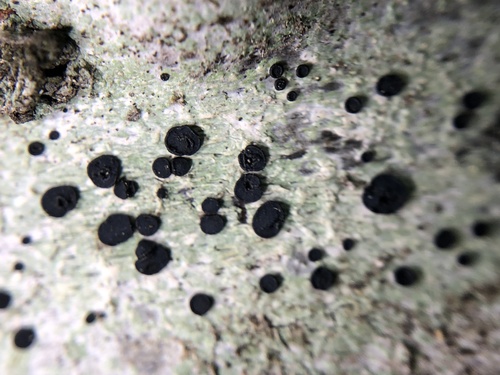
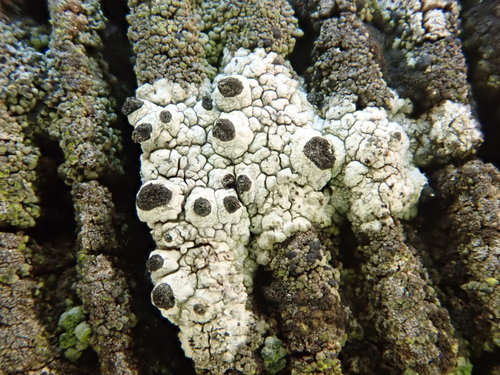
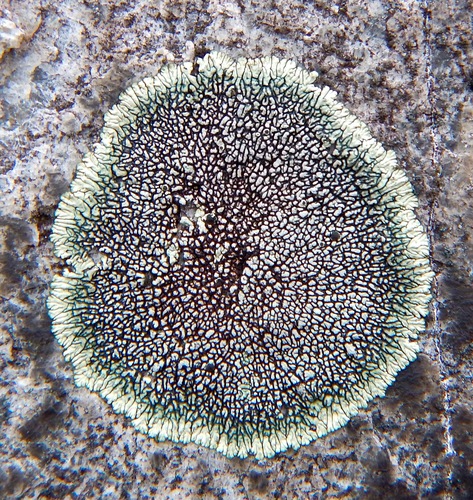
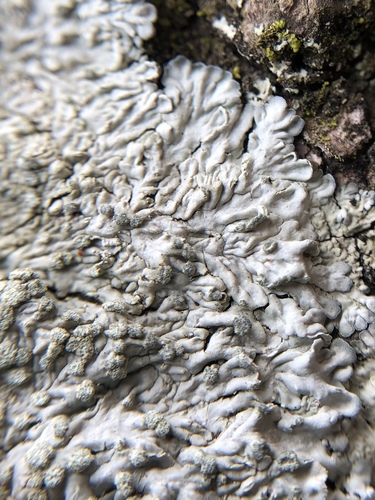
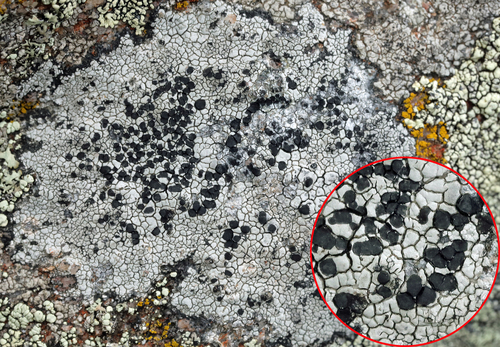
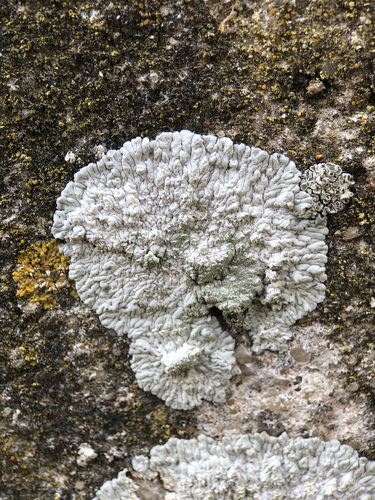
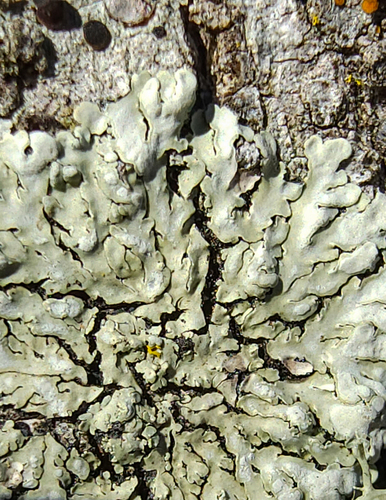
The thallus of Pyxine subcinerea is 3–8 cm (1.2–3.1 in) wide. Its upper surface ranges in colour from yellowish grey to grey, brownish grey, or olive-grey. The lobes that make up the thallus are 0.3–1.5 mm (0.01–0.06 in) wide, somewhat tightly appressed to the substrate. They are more or less flat, but often become somewhat concave near their tips. Lobe surfaces are pruinose, with pruina forming dense point-like patterns near lobe tips. This pruina contains weddellite, a mineral form of calcium oxalate. Distinct pseudocyphellae are present on the margins of the lobes, and soralia develop near lobe margins. The medulla is quite thin, and yellow in its upper section. The lower surface is black at the centre, and fades to a paler colour towards the margin. Rhizines are more or less dense, and are branched. The upper cortex is paraplectenchymatous, meaning its hyphae are oriented in all directions, while the lower cortex is prosoplectenchymatous, with all hyphae oriented in a single direction. Apothecia, the species' reproductive structures, are common in specimens from tropical and subtropical regions; they measure 0.3–1.5 mm (0.01–0.06 in) wide and have an indistinct internal stipe. Apothecia are not typically found on European specimens of Pyxine subcinerea. Ascospores of this species measure 13–22 by 6–9 μm. Conidia are bacilliform, measuring 3–4 μm by approximately 1 μm. The main secondary compound produced by Pyxine subcinerea is lichexanthone; when illuminated with UV light, this compound causes the lichen to glow golden-yellow. All standard lichen spot tests give negative results for this species. Pyxine subcinerea has a mostly pantropical distribution. It grows most often on bark, but has also been found growing on rock, and in one recorded case, on mortar. In Europe, it has been reported from the Azores and Italy. It has also been recorded in Africa (Ethiopia, Uganda, Kenya, Tanzania, the Seychelles, Rwanda, and Angola), across all of Asia including China, Australia, and New Zealand. In the eastern United States, its range extends from subtropical regions to more temperate areas, covering the states of New York, Illinois, and Ohio down to Florida, Louisiana, and Texas. It has been recorded growing on the tree genera hornbeam, hickory, hibiscus, juniper, sweetgum, magnolia, oak, locust, elm, and Prunus. It prefers low elevations, and occurs in hardwood-pine forests as well as more open areas including farms, glades, and gardens. Pyxine subcinerea is relatively resistant to air pollution, and has been studied as a candidate species for biomonitoring. It bioaccumulates toxic heavy metals from the air, retaining these pollutants in its thallus. The thallus can later be sampled and assayed to measure heavy metal concentrations.