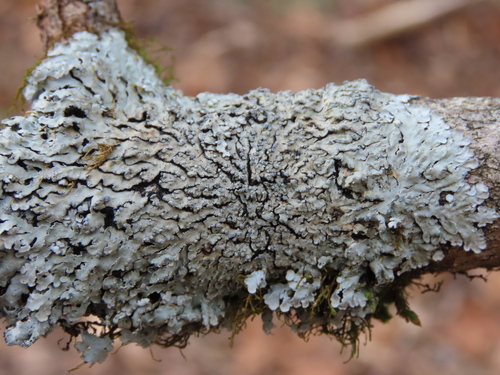
About Pyxine sorediata (Ach.) Mont.
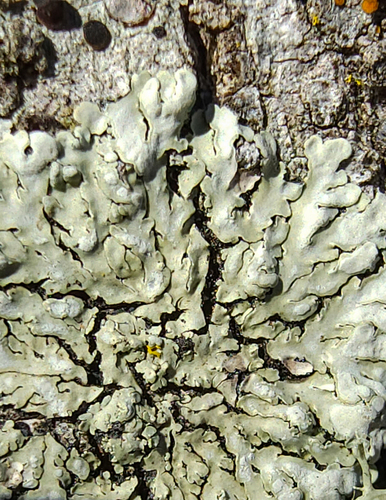
Pyxine sorediata, the largest species in the Pyxine genus, has a foliose thallus that varies in colour from dull bluish-grey to green-grey. The lobes that make up the thallus are 1–2.5 mm wide, have a pruinose coating at their tips, grow in close contact with one another, and often overlap. White pseudocyphellae appear on the lobe margins, contrasting with the main colour of the lobe; these structures are concentrated along lobe margins and rarely occur on the lamina. The medulla is light yellow to yellow, and this yellow colour is sometimes visible within the soralia. The underside of the thallus is black to greyish black, and has small rhizines that anchor the lichen to its substrate. Soralia, the structures that produce soredia, develop on lobe margins, but sometimes form round patches on the lamina. The soredia, which are reproductive structures, are coarse and grainy, dark grey in colour, and tend to give a grey colour to the central portion of the thallus. Apothecia are very rare in this species. Its ascospores measure 12–17 by 6–8 μm. This species shows no reaction to standard lichen spot tests. Secondary chemicals identified in Pyxine sorediata include atranorin and unidentified triterpenes. In terms of habitat and distribution, this lichen is widely distributed in northeastern North America, where it grows on bark, acidic rocks, and moss. In Europe, the species is generally rare; here it is most often collected from mossy rocks. Confirmed European locations include the Pyrenees, the Caucasus, the Uholka-Shyrokyi Luh primeval beech forest in the Ukrainian Carpathians, the eastern coast of Lake Baikal in Siberia, and its northernmost European record comes from the Bavarian-Bohemian Forest. In Australia, Pyxine sorediata grows in uniform tropical, subtropical, and warm temperate areas; specimens from Queensland have been collected at elevations up to 1,000 metres (3,300 ft). It has also been recorded in East Africa, Japan, South Korea, and China.