About Pyxicephalus edulis Peters, 1854
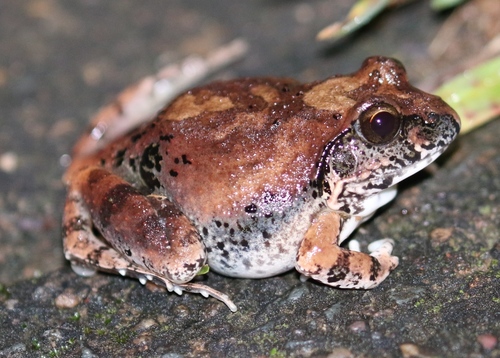
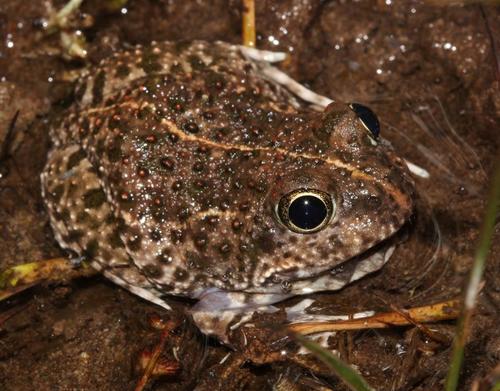
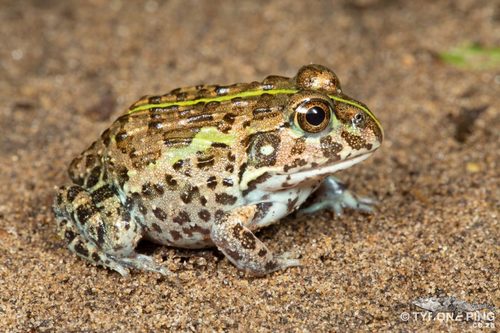
The edible bullfrog (Pyxicephalus edulis Peters, 1854) is a large-bodied frog. Males typically reach 8.3–12 cm (3.3–4.7 in) in snout–to–vent length, while females reach 8.5–11 cm (3.3–4.3 in). Exceptionally large males can grow up to 13.8 cm (5.4 in), but this species never reaches the size attained by the closely related African bullfrog (P. adspersus). Females are far less bulky than males, and typically weigh only half as much as an adult male. Its broad mouth holds two tooth-like structures on the lower jaw that point upwards. The skin bears small, relatively rounded warts, and short lateral ridges that never extend fully from the head to the end of the body; the shape of these ridges changes significantly as the frog grows. Juvenile frogs are quite sturdy and almost plump, while adult individuals are dorsoventrally flattened. As the frog grows, its eyes shift to a more central position on the head, and the eyes of adult frogs are very protruding. This species has a distinct, large, oval-shaped tympanum. The front feet are unwebbed, while the hind feet are webbed. The back of an adult is generally uniform yellow-green to drab olive-green; males are typically greener than females, which are more olive-brown. Females may have a pale stripe along the backbone, plus light lines on the ridges and warts, and these markings are far less common in males. Newly metamorphosed young frogs usually have a bright light green stripe down the center of the back. Their dark green skin has gold-brown speckles and black markings, which form black bars on the lips and extremities. The underside of the body is uniformly white or cream; males have a dark yellow throat. This species is distributed across Angola, Benin, Botswana, Burkina Faso, Chad, Kenya, Malawi, Mali, Mauritania, Mozambique, Nigeria, Tanzania, Zambia and Zimbabwe. There is some taxonomic confusion around its range due to misidentification with similar closely related species, like the African bullfrog Pyxicephalus adspersus. Its habitat includes flooded grasslands. In northern Cameroon, it tends to prefer open marshy areas, while other regions report it living in flooded meadows and ditches. It shows a preference for clay or sand substrates. Locally, this frog is widely harvested for human consumption, though it is not gathered at a subsistence level. It is also occasionally found in the international pet trade.