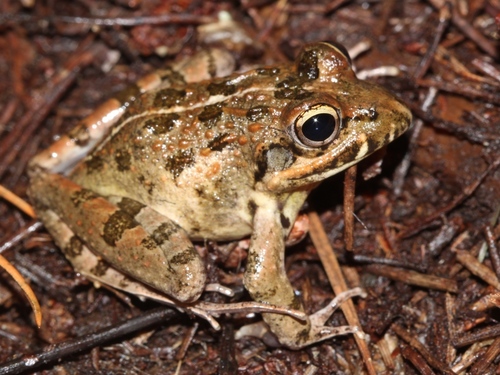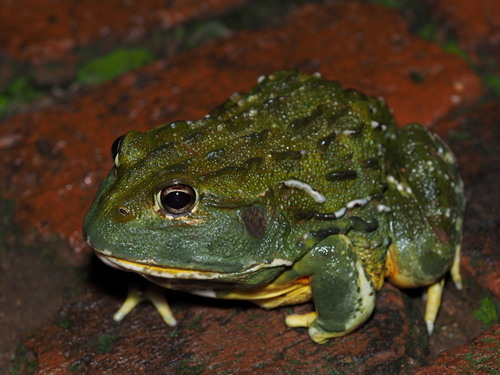
About Pyxicephalus adspersus Tschudi, 1838
Pyxicephalus adspersus, commonly called the African bullfrog, giant bullfrog, South African burrowing frog, or pixie frog (a name shortened from its scientific name), is a frog species belonging to the family Pyxicephalidae. This species is found in Angola, Botswana, Kenya, Malawi, Mozambique, Namibia, South Africa, Tanzania, Uganda, Zambia, and Zimbabwe. It is possibly also present in the Democratic Republic of the Congo, but has been completely extirpated from Eswatini. African bullfrogs have long been mistaken for the edible bullfrog (P. edulis), and the exact species boundaries and range limits between the two are still not fully understood. Additionally, P. angusticeps, a species native to coastal East Africa, was only confirmed as a separate valid species in 2013. The natural habitats of the African bullfrog include moist to dry savannas, subtropical to tropical dry shrubland, intermittent freshwater lakes, intermittent freshwater marshes, arable land, pastureland, canals, and flooded ditches. It is one of the largest anuran species on Earth, ranking sixth in size after the goliath frog, helmeted water toad, Lake Junin frog, Blyth's river frog, and cane toad. Breeding for African bullfrogs usually begins after around 65 mm (2.6 in) of rain falls over two days. They breed in shallow, temporary water bodies like pools, pans, and ditches. Females lay eggs at the shallow edge of the water body, but fertilization occurs above the water surface. Males call during the rainy season; each call is roughly one second long and sounds like a low-pitched whoop. Male African bullfrogs use two different breeding strategies based on their age. Young males gather in a small area, which may only span 1 to 2 square meters (11 to 22 square feet) of shallow water. Larger males take up the center of these breeding leks or arenas, and try to drive away other males. Fights between large males are common, and can cause injury or even death. The dominant male works to stop other males from breeding. A female approaches the group of males by swimming along the water's surface until she is within a few meters of the group. She then dives to avoid smaller males, and surfaces in the area controlled by a large male in the center of the group, which ensures she mates with the dominant male. Females lay between 3,000 and 4,000 eggs in a single clutch. Once tadpoles hatch, they begin feeding after two days on vegetation, small fish, invertebrates, and even other tadpoles. Dominant defending males stay to watch over the clutch, and tadpoles complete metamorphosis within three weeks. Throughout the tadpoles' development, the father guards his offspring. Because of the male's highly protective behavior, he will pounce and bite any creature he identifies as a threat to the tadpoles. If the breeding pool begins to dry out, the father uses his legs and head to dig a canal connecting the drying pond to a larger, permanent pond. He continues guarding the tadpoles until they are old enough to survive on their own, though he may also eat some of his own offspring. African bullfrogs are kept as exotic pets in many countries worldwide, and most individuals sold as pets are captive-bred. Captive pet African bullfrogs can live up to 35 years, and they are generally regarded as easygoing, low-maintenance pets. This species is also eaten as a delicacy in Namibia.