About Pyura haustor (Stimpson, 1864)
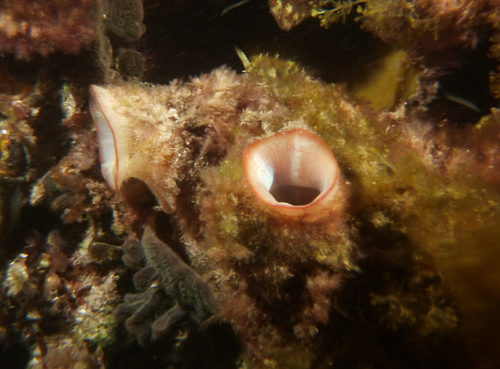
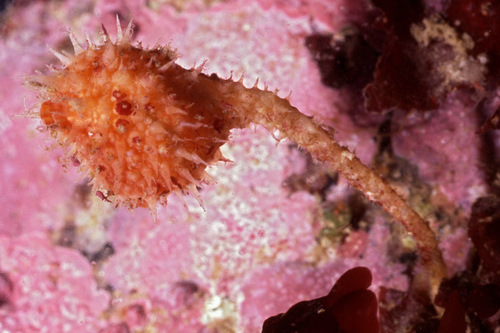
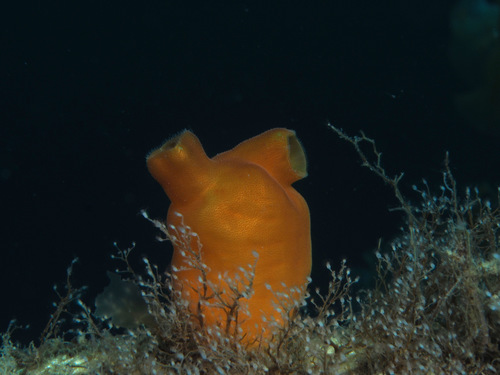
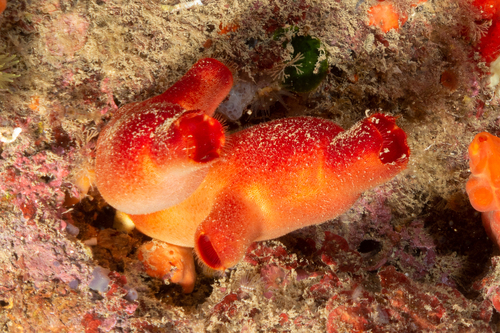
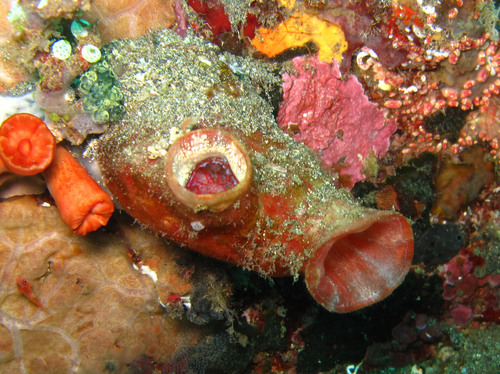
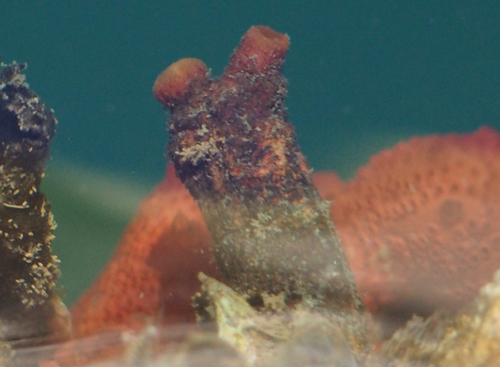
This sea squirt, Pyura haustor, is nearly as tall as it is wide, and grows to around 5 by 3.5 cm (2.0 by 1.4 in). Unlike some other members of its genus, it does not attach to the substrate via a stalk. Instead, it attaches over a wide base, giving it a roughly globular shape, with two clearly visible siphons that project upward. When the animal is feeding, these siphons can extend a long distance, and they can be fully retracted when the animal is threatened. The tunic of Pyura haustor is tough, wrinkled and folded, and it does not have any spiny projections. Its body is usually dark brown, with a red tinge on the siphons, but much of its outer surface is often hidden by sand, shell fragments or debris stuck to the tunic, or the tunic may become overgrown by other organisms. Pyura haustor is native to the northeastern Pacific Ocean, with a range that extends from the Shumagin Islands in Alaska southward to San Diego County, California. It attaches to rocks, piers, pilings and floats, and also to the holdfasts of kelp. It can live in both sheltered and exposed marine locations, but in the San Juan Islands where it is common, it does not inhabit areas with the strongest currents. Its depth range runs from the lower intertidal zone down to around 200 m (660 ft). Like all tunicates, this sea squirt draws large volumes of water in through its buccal siphon, filters out edible food particles, and expels the filtered water out through its atrial siphon. A variety of invertebrate larvae are among the planktonic particles that this species ingests, though researchers have found that the feeding activity of Pyura haustor is not great enough to noticeably reduce local larval populations. Its diet includes the eggs and larvae of crustaceans, echinoderms, mollusks and other tunicates. The eggs of this sea squirt are gray, but there are conflicting scientific reports on whether this species releases its eggs directly into the water column, or broods its developing embryos on its body. The seastar Solaster stimpsoni is a known predator of this tunicate.