About Python sebae (Gmelin, 1789)
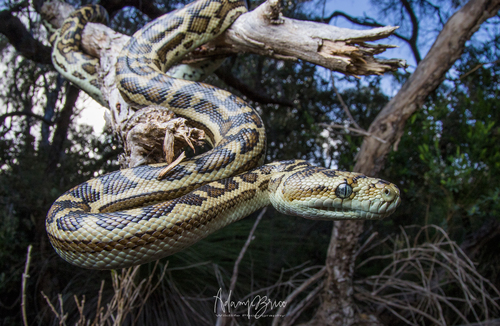
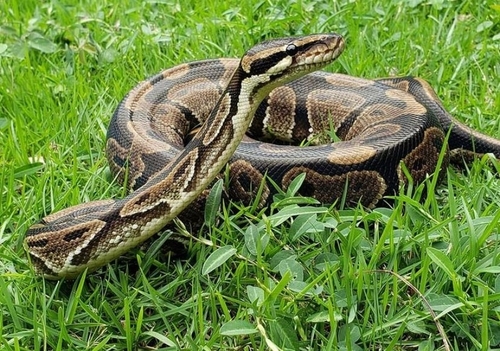
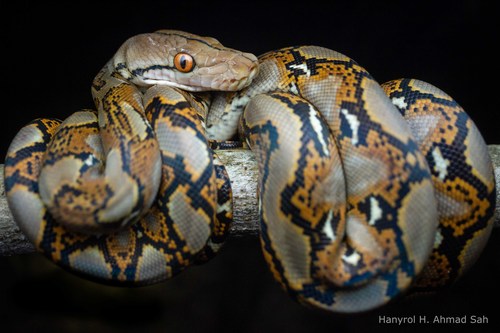
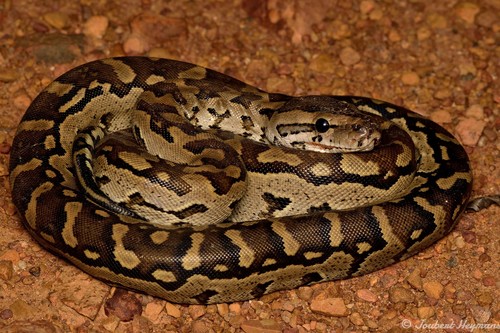
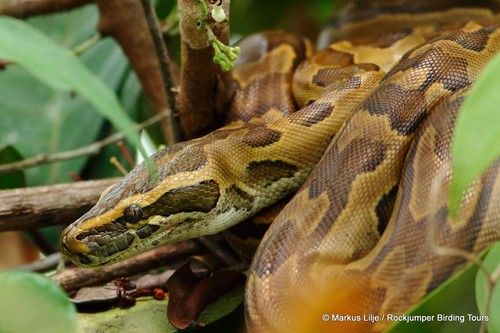
Python sebae, commonly known as the Central African rock python, is Africa's largest snake species and one of the world's largest snakes. Adult Central African rock pythons measure 3 to 3.53 m (9 ft 10 in to 11 ft 7 in) in total length including the tail; only unusually large specimens are likely to exceed 4.8 m (15 ft 9 in). Reports of specimens over 6 m (19 ft 8 in) are considered reliable, though larger individuals have never been confirmed. Reported weights generally fall in the range of 55 to 65 kg (121 to 143 lb) or more, and exceptionally large specimens may weigh 91 kg (201 lb) or more. On average, large adult Central African rock pythons are heavily built. They are typically more heavily built than most specimens of the somewhat longer reticulated python, as well as Indian and Burmese pythons, and far more heavily built than the amethystine python. However, this species is on average less heavily built than the green anaconda. Some authors agree that this species can exceptionally exceed 90 kg (200 lb), and it may be the second heaviest living snake. One specimen reportedly measuring 7 m (23 ft 0 in) in length was killed by K. H. Kroft in 1958, and was claimed to have contained a 1.5 m (4 ft 11 in) juvenile Nile crocodile in its stomach. An even larger authenticated specimen was shot in the Gambia and measured 7.5 m (24 ft 7 in). Body size of this species varies considerably across different regions. In general, individuals are smaller in densely populated human regions such as southern Nigeria, and only reach their maximum length in lower human population density areas like Sierra Leone. Males are typically smaller than females. One individual captured in Côte d'Ivoire was allegedly 9.96 m (32.7 ft) long. This snake has a thick body covered in colored blotches, which often join to form a broad, irregular stripe. Body markings range in color from brown, olive, chestnut, and yellow, and fade to white on the underside. The head is triangular, marked on top with a dark brown "spear-head" outlined in buffy yellow. It has many sharp, backwardly curved teeth. A distinctive triangular subocular marking is found beneath the eye. Like all pythons, the scales of the Central African rock python are small and smooth. Scales around the lips hold heat-sensitive pits, used to detect warm-blooded prey even in the dark. Unlike more advanced snakes which only have one lung, pythons have two functioning lungs. They also have small, visible pelvic spurs that are believed to be vestigial hind limbs. The Central African rock python (P. sebae) can be distinguished from the closely related Southern African rock python (P. natalensis) in several ways. While the southern species has a similar overall color to the northern Central African species, it is described as "drabber". P. sebae has two prominent light lines that run from the nose, over the eye, to the back of the head; these lines are much duller in P. natalensis. The northern Central African species also has considerably larger head scales than the southern species. P. natalensis is typically smaller in size than P. sebae: P. natalensis reaches an average length between 2.8 and 4 m, with a maximum measured size of 5.8 m, while P. sebae has an average length between 2.7 and 4.6 m, with a maximum measured size of 6.5 m. In P. natalensis, the dark patch in front of and behind the eye is paler and narrower than in P. sebae, creating the appearance of a dark stripe rather than the yellow stripe seen at eye level in P. sebae. The Central African rock python is found across most of tropical sub-Saharan Africa, ranging from Senegal east to Ethiopia and Somalia, and south to northern Angola and northern Tanzania. P. sebae occupies central and western Africa, while P. natalensis has a more eastern and southern distribution from southern Kenya to South Africa. This species inhabits a wide range of habitats, including forest, savanna, grassland, semidesert, and rocky areas. It is particularly associated with regions of permanent water, and occurs on the edges of swamps, lakes, and rivers. It also readily adapts to disturbed habitats, so it is often found near human habitation, especially in cane fields. Feral Central African rock pythons were noted in the Florida Everglades in the 1990s, and another individual was found there in 2009. It is feared that the species is becoming established as an invasive species in Florida, alongside the already established Burmese python. Reproduction for this species takes place in the spring. Central African rock pythons are oviparous, laying between 20 and 100 hard-shelled, elongated eggs in an old animal burrow, termite mound, or cave. The female provides surprising maternal care, coiling around the eggs to protect them from predators and possibly help incubate them until they hatch after around 90 days. Unusually for snakes in general, and pythons in particular, the female guards the hatchlings for up to two weeks after they hatch to protect them from predators. Hatchlings measure between 45 and 60 cm (17.5 and 23.5 in) in length, and appear almost identical to adults aside from having more contrasting colors. Individuals can live over 12 years in captivity.