About Python regius (Shaw, 1802)
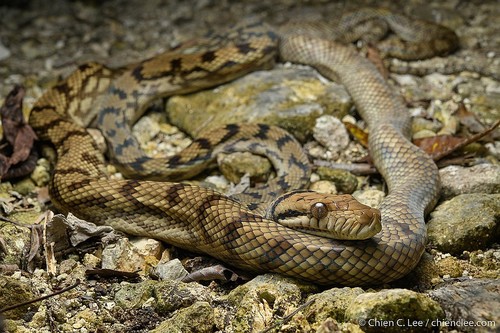
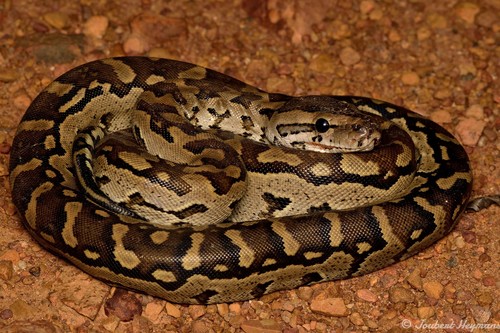
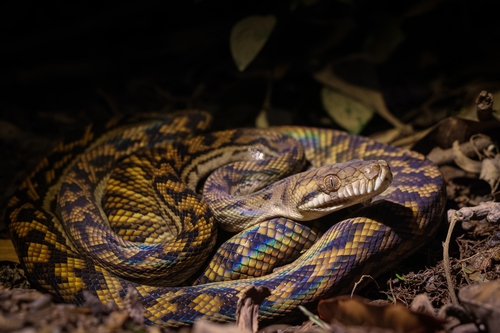
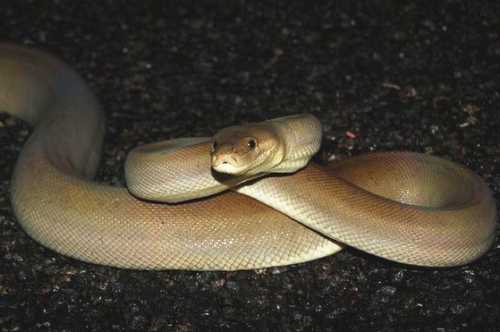
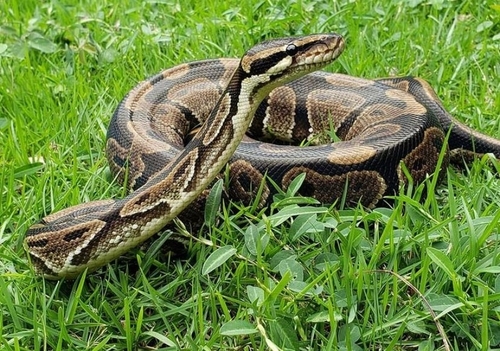
Description: The ball python (Python regius) may be black, albino, or dark brown, with light brown blotches along its back and sides. Its white or cream-colored belly has scattered black markings. It is a stocky snake with a relatively small head and smooth scales. The maximum adult length this species reaches is 182 cm (72 in). Males typically have 8 to 10 subcaudal scales, while females typically have 2 to 4. On average, females have a snout-to-vent length of 116.2 cm (45.7 in), a jaw 44.3 mm (1.74 in) long, a tail 8.7 cm (3.4 in) long, and reach a maximum weight of 1.635 kg (3.60 lb). Males are smaller: on average, they have a snout-to-vent length of 111.3 cm (43.8 in), a jaw 43.6 mm (1.72 in) long, a tail 8.6 cm (3.4 in) long, and reach a maximum weight of 1.561 kg (3.44 lb). Both sexes have pelvic spurs on both sides of the vent. Males use these spurs to grip females during copulation. Males usually have larger spurs. The most reliable way to determine sex is by manually everting the male hemipenes, or inserting a probe into the cloaca to check for an inverted hemipenis. Distribution and habitat: The ball python is native to west Sub-Saharan Africa, ranging from Senegal through Cameroon to Sudan and Uganda. It prefers grasslands, savannas, and sparsely wooded areas. Behavior and ecology: Ball pythons are typically nocturnal or crepuscular, meaning they are active during dusk, dawn, and/or nighttime. This species is best known for its characteristic defense strategy: when threatened, it coils into a tight ball, tucking its head and neck away in the center. It usually uses this defensive behavior instead of biting, which makes the species easy for humans to handle and has contributed to its popularity as a pet. In the wild, ball pythons prefer mammal burrows and other underground hiding spots, where they also aestivate. Males tend to exhibit more semi-arboreal behaviors, while females tend to be more terrestrial. Reproduction: Female ball pythons are oviparous, laying 3 to 11 relatively large, leathery eggs. The eggs hatch after 55 to 60 days of incubation. Young male pythons reach sexual maturity at 11 to 18 months old, while females reach sexual maturity at 20 to 36 months old. Age is only one factor that determines sexual maturity and breeding ability; weight is a second key factor. Males can breed once they reach 600 g (21 oz) or more, but they are often not bred in captivity until they reach 800 g (28 oz). Some captive males have been recorded starting breeding at 300 to 400 g (11 to 14 oz). In the wild, females can breed at weights as low as 800 g (28 oz), though weights of 1,200 g (42 oz) or more are most common. In captivity, breeders generally wait to breed females until they weigh no less than 1,500 g (53 oz). Parental care of eggs ends once the eggs hatch, and the female leaves offspring to fend for themselves. Parthenogenetic reproduction has been demonstrated in a pet ball python via genetic comparison of a mother and her early-stage embryos.