About Python molurus (Linnaeus, 1758)
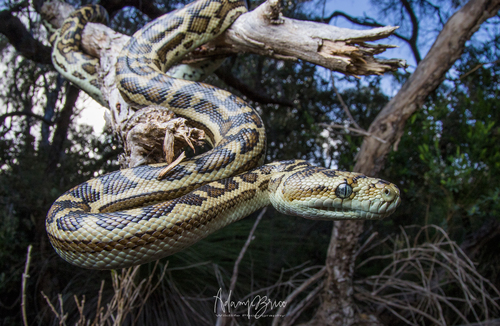
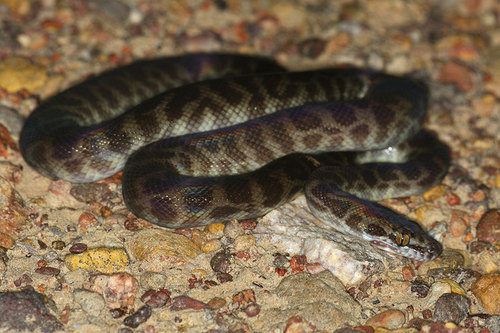
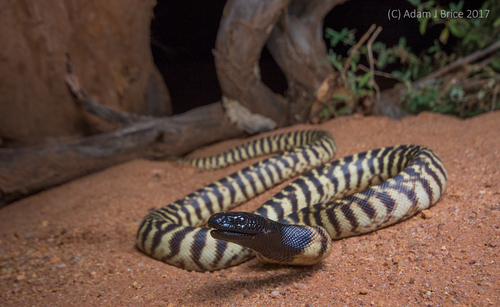
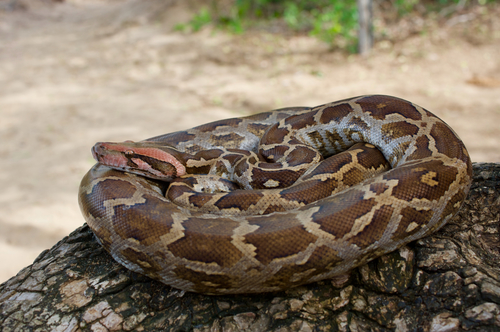
The Indian rock python, Python molurus, has a base color pattern that ranges from whitish to yellowish, with blotched patterns that vary in shade from tan to dark brown. The exact coloration varies based on the python's terrain and habitat: specimens from the hill forests of the Western Ghats and Assam are darker, while pythons from the Deccan Plateau and Eastern Ghats are typically lighter. All pythons, including this species, are non-venomous.
The nominate subspecies found in India typically grows to 3 meters (9 feet 10 inches) in length. This average size is supported by a 1990 study conducted at Keoladeo National Park, where 25% of the python population measured between 2.7 and 3.3 meters (8 feet 10 inches to 10 feet 10 inches) long. Two individuals in the study measured nearly 3.6 meters (11 feet 10 inches). Due to historical confusion with the Burmese python, exaggerated size claims, and inaccurate measurements from stretched skins, the maximum length of this subspecies is hard to determine. The longest scientifically recorded specimen, collected in Pakistan, was 4.6 meters (15 feet 1 inch) long and weighed 52 kilograms (114 pounds 10 ounces). In Pakistan, Indian pythons commonly reach a length between 2.4 and 3.0 meters (7 feet 10 inches to 9 feet 10 inches).
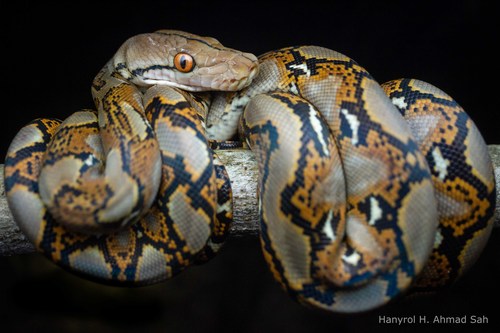
The Indian python can be distinguished from the Burmese python (Python bivittatus) by several traits: it has light "eye" markings in the centers of spots on the sides of its trunk, it has reddish or pinkish light stripes on the sides of its head, the diamond-shaped spot on its head is blurred at the front, it is typically lighter in color with dominant tones of brown, reddish-brown, yellowish-brown, and grayish-brown, and it usually prefers drier, more arid environments, while P. bivittatus inhabits moist, grassy areas.
The Indian python is distributed across nearly the entire Indian subcontinent south of the Himalayas, including southern Nepal and Bhutan, Sri Lanka, southeastern Pakistan, and Bangladesh, and it is thought to possibly be present in northern Myanmar. It lives in a wide range of habitats, including grasslands, swamps, marshes, rocky foothills, woodlands, open forest, and river valleys. It requires a reliable source of water, and hides in abandoned mammal burrows, hollow trees, dense water reeds, and mangrove thickets.
The Indian python is oviparous. A single female can lay up to 100 eggs, which she protects and incubates. To incubate the eggs, females are able to raise their body temperature above the ambient temperature through muscular contractions. Hatchlings measure 45 to 60 cm (18 to 24 inches) long and grow quickly. An artificial incubation method using climate-controlled environmental chambers has been developed in India to successfully raise hatchlings from abandoned or unattended eggs.