About Pyrrhura melanura (Spix, 1824)
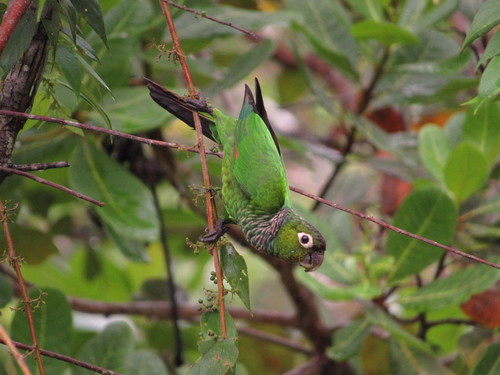
The maroon-tailed parakeet (Pyrrhura melanura, first described by Spix in 1824) measures 23 to 25 cm (9.1 to 9.8 in) in length and weighs approximately 83 g (2.9 oz). Males and females have identical appearance. For the nominate subspecies P. m. melanura, adults have a mostly green head, with brown coloration on the crown and nape. Their upperparts are green. Their throat, the sides of the neck, and their breast are dark green with buffy whitish feather edges that create a scaly appearance. The rest of their underparts are green. Their wings are mostly green, with red and yellowish orange primary coverts; their primary flight feathers are mostly blue. The upper surface of their tail is maroon with a green base, and the under surface is dusky grayish. Their bill is grayish, their iris is dark brown with bare white skin surrounding it, and their legs and feet are blackish gray. Immature birds are similar to adults, but have less red on the primary coverts. There are four additional recognized subspecies with distinct physical traits. P. m. pacifica is darker than the nominate subspecies, has no yellow on its primary coverts, darker and narrower breast scaling, a gray eye ring, and a blackish bill. It also has heavier throat scaling than subspecies P. m. souancei, plus red carpals and a brownish red belly. P. m. chapmani is larger than the nominate, has less red on the wing, a red patch on the belly, and its breast scaling extends around the back of the neck. P. m. souancei has heavier throat scaling than the nominate, no yellow on the primary coverts, sometimes red on its carpals, a brownish red belly, and a blacker undertail. P. m. berlepschi has no described distinct physical traits in this summary.
Each subspecies has a distinct geographic range. P. m. pacifica is found on the Pacific slope of the Andes, from Colombia's Nariño Department south to Ecuador's Cotopaxi Province. P. m. chapmani occurs in the upper valley of the Magdalena River on the eastern slope of Colombia's Central Andes, in Tolima and Huila departments. The nominate subspecies P. m. melanura is found in the upper Amazon Basin in southern Venezuela, southeastern Colombia, eastern Ecuador, northeastern Peru, and northwestern Brazil. P. m. souancei occurs on the eastern slope of the Andes from the Serranía de la Macarena in south-central Colombia into eastern Ecuador, and possibly into northern Peru. P. m. berlepschi lives on the eastern slope of the Andes from Morona-Santiago Province in Ecuador to the Huallaga River valley in northern Peru.
The maroon-tailed parakeet inhabits the canopy and edges of multiple landscape types, including wet lowland premontane forest, cloudforest, várzea, terra firme, and partially cleared areas. It is most common at elevations between 500 and 1,700 m (1,600 and 5,600 ft). Different subspecies have different maximum elevation ranges: P. m. pacifica ranges up to 2,200 m (7,200 ft), while P. m. souancei and P. m. berlepschi both range up to 3,200 m (10,500 ft). P. m. chapmani is an exception, with an elevation range between 1,600 and 2,800 m (5,200 and 9,200 ft).