About Pyrrhura frontalis (Vieillot, 1818)
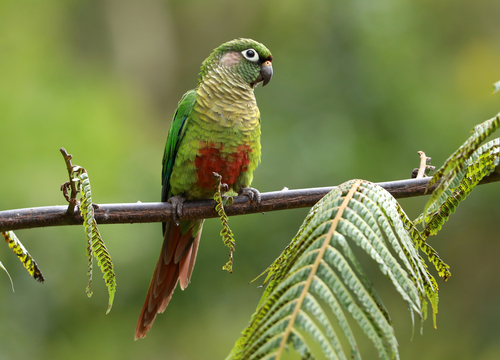
Pyrrhura frontalis (Vieillot, 1818), commonly called the maroon-bellied parakeet, measures between 25 and 28 cm (9.8 to 11.0 in) in length. Its plumage is primarily green, with a maroon belly patch, scaly yellow-green barring on the breast and sides of the neck, a whitish ear patch that is often tinged brown, and maroon undertail feathers. The species-specific name frontalis refers to its dark maroon frontlet, a trait that distinguishes it from most closely related species. The outer webs of its primary feathers are blue, the inner webs are green, and the tips of the primaries are dark. The species has a black beak. The nominate subspecies P. f. frontalis has a greenish-yellow uppertail that shifts to a broad reddish tip, while the subspecies P. f. chiripepe has a greenish-yellow uppertail without this reddish tip. A third proposed subspecies, kriegi, was first described from Bahia by Alfred Laubmann in 1932, but it is now universally recognized as a junior synonym of the nominate subspecies. This proposed taxon was distinguished by a narrow brownish-red tail tip, and it actually represents just a morph or intermediate genotype that makes up only 20% of specimens even within its supposed native range. The name Krieg's conure is sometimes used for this morph in aviculture, and some aviculturists breed this morph exclusively. Despite this classification, the morph is fully interfertile with normally colored individuals of the species. This parakeet is common in woodland and forest edge habitats. In the northern portion of its range, it mainly occurs in highlands up to 1,400 m (4,600 ft) elevation, while in the rest of its range it is primarily found in lowlands up to 1,000 m (3,300 ft). It tolerates habitat disturbance well, and can even be found living in urban parks such as those in Rio de Janeiro and São Paulo, where it feeds in garden areas. Flock sizes are typically 6 to 12 individuals, though flocks may reach as large as 40 individuals. Like other members of the genus Pyrrhura, this species feeds primarily on fruits, flowers, and similar plant matter, and it rarely joins mixed-species feeding flocks.