About Pyrrhura cruentata (Wied-Neuwied, 1820)
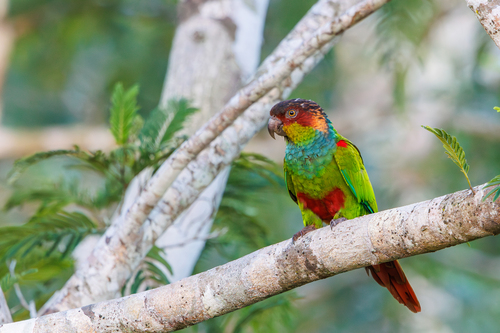
This colourful parakeet, Pyrrhura cruentata, is a mostly green bird with prominent red patches on its belly, rump, shoulder, and the areas before, below, and behind the eye. Its crown is dark brown to blackish, turning mottled on the nape of the neck. A broad, bright blue bib covers its chest, and this blue colour extends thinly around the back of the neck to form a faint collar. The outer primary feathers are blue, the upper side of the tail is olive-green, and the underside is brownish red. This species lives in the canopy of lowland humid forest and forest edges, and occasionally occurs at elevations up to 960 meters. It has also been recorded in small clearings and selectively logged forest. It can persist, or at least persisted historically, in agricultural areas where many forest trees are retained, such as shade cocoa plantations. It feeds on the seeds and fruit of secondary growth trees including Trema micrantha and Cecropia. Feeding on agricultural crops has not been observed in wild populations. Breeding apparently takes place during the austral spring. Females lay 2–4 eggs in a tree cavity. Historically, Pyrrhura cruentata was common across most of southeast Bahia, Espírito Santo, eastern Minas Gerais, and Rio de Janeiro, Brazil. Today, its distribution is highly fragmented, and it is now mostly restricted to isolated protected reserves. Its largest populations are found in Sooretama Biological Reserve and the adjacent Linhares Forest Reserve in Espírito Santo. The species remains common at Estação Vera Cruz, formerly known as the Porto Seguro Reserve, in Bahia. It can be relatively common in other remaining areas, but population numbers appear low in the large Chapada da Diamantina and Monte Pascoal National Parks in Bahia.