About Pyrrholaemus sagittatus (Latham, 1802)
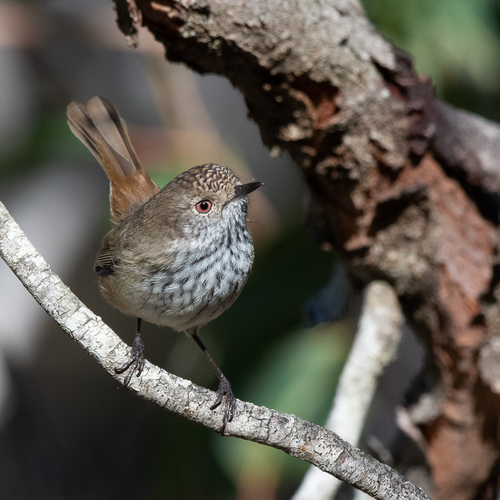
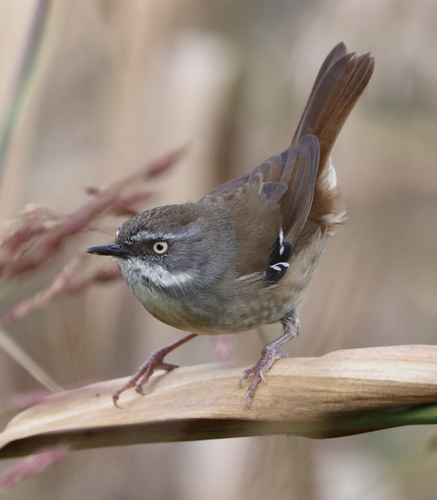
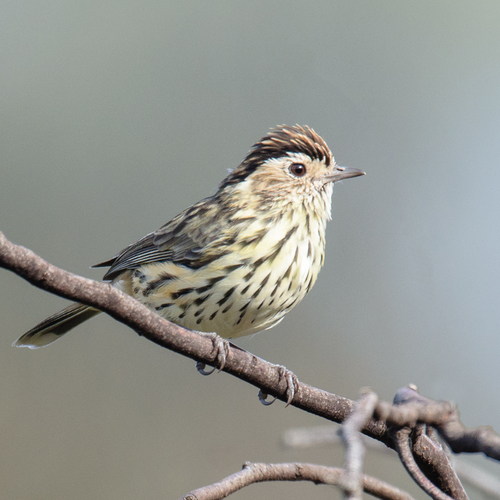
Pyrrholaemus sagittatus, commonly called the speckled warbler, is a small ground-dwelling warbler species. Adults measure 11.5 to 12.5 centimetres (4.5 to 4.9 inches) in length, and average 13.5 grams (0.48 oz) in weight. It has an off-white face with buffy-brown streaking on the ear coverts, and a brown crown marked with white speckles. Its eyes are brown, the bill is dark grey-brown, and the legs are pinkish-brown. Males have a black upper edge to the brow, while females have a reddish-brown upper brow edge. The upperparts plumage is grey-brown with darker streaks. The dark brown tail has a black subterminal band and white tips, and is typically held in a horizontal position. The underparts are yellowish-white and heavily marked with black streaks. Juveniles have a similar appearance to adult females, but the top of the head has more diffuse spotting. The speckled warbler is native to southeastern Australia. It has a patchy distribution in Queensland, occurring roughly southeast of the line between Mackay and Charleville, and becomes more common toward the extreme southeast of the state. In New South Wales, it lives across the New England Tablelands and the South West Slopes, extending west to the Pilliga Scrub and Griffith in the Riverina, and east into the Hunter Valley. It is fairly common in the Australian Capital Territory. In Victoria, it occupies a broad strip that includes Chiltern Box-Ironbark and Warby-Ovens National Parks, the Bendigo region, the Brisbane Ranges, the You Yangs, and extends west to Balmoral on the western side of the Grampians. Across its entire range, the species ranges from scarce to moderately common. It prefers open eucalypt woodland habitat with rocky gullies, tussocky grass, scattered logs, and sparse shrubbery.