About Pyrrholaemus brunneus Gould, 1841
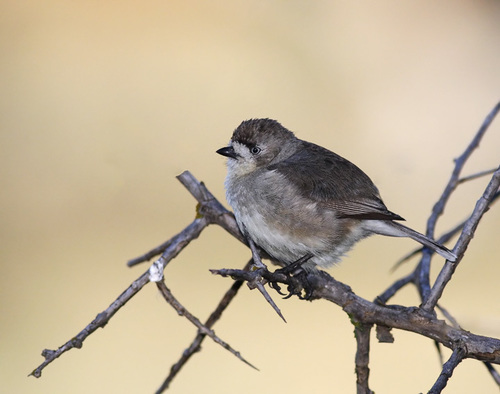
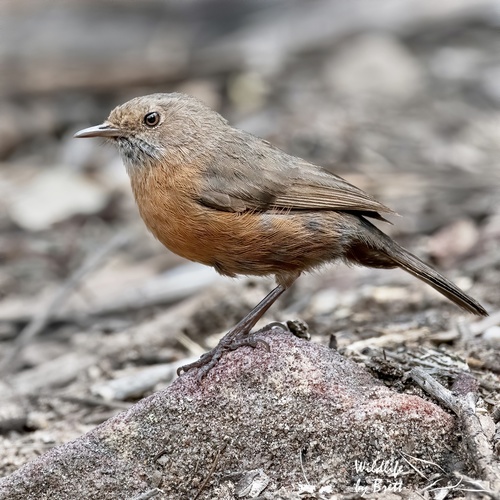
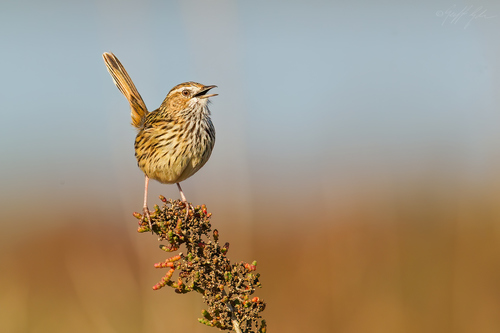
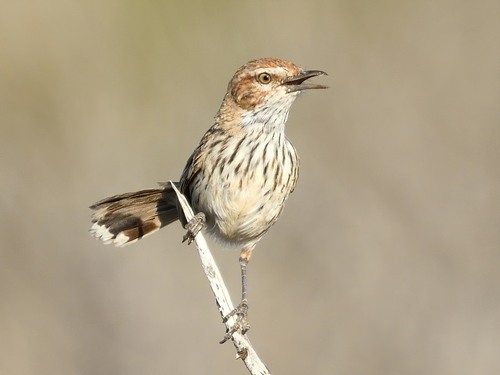
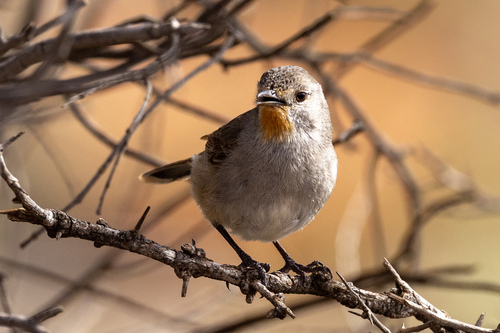
Pyrrholaemus brunneus, commonly called the redthroat, is a small shy greyish-brown bird that measures 11–12 cm (4.3–4.7 in) long. It is most often observed swiftly darting through low branches and shrubs, or hopping across the ground in a mouse-like manner. Only adult males have the distinctive small rusty-brown throat patch that gives the species its common name; the absence of this patch makes identifying females and juveniles more difficult. The upper head, body, wings, and tail are dark brownish-grey, with darker coloring on the rump and tail. The underbody is predominantly whitish-grey, with a whiter belly, and pale buff coloring that blends into the flanks and undertail-coverts. The tips of the outer tail feathers have prominent white patches, which are visible during flight and when the tail is folded. Fine off-white scalloping appears on the forehead, and off-white eye rings and lores merge into the lighter underparts of the body. The redthroat may be confused with thornbill species, which have a more compact body and a shorter tail than the redthroat. It is unlikely to be mistaken for fieldwrens or heathwrens, which hold their tails more strongly upturned when at rest. The redthroat has a melodious canary-like call, with sustained warbling and loud cheery notes. In addition to its own calls, the redthroat can mimic the calls of numerous other birds, including the pied butcherbird, rufous fieldwren, grey fantail, fairywrens, and thornbills. It has even been recorded mimicking the non-vocal whistling wingbeat sound made by a flying crested pigeon. Both sexes call throughout the year, but male calls become more sustained during the breeding season. The species is vocal while foraging, and will also sing when perched atop shrubs and taller trees. The redthroat is endemic to mainland Australia, occurring in all states and territories except the Australian Capital Territory and Tasmania. It is most prevalent in Western Australia and South Australia, where it has a widespread but scattered distribution across most of the state. In Western Australia, the species is not found in the far north or the south-east, but is common across the state's mid-latitudes. In the Northern Territory, it is restricted to the southern part of the territory, around the Simpson Desert and the MacDonnell Ranges. In Queensland, it is restricted to inland south-western regions. In Victoria, it is restricted to the mallee regions of the state's northwest. In New South Wales, it is only known to occur in the far west, with several core populations including those around Broken Hill, Tibooburra, Penarie and Nearie Lake Nature Reserve. The species is thought to be mostly sedentary, with no evidence of seasonal migration. All individuals recaptured after banding have been found within 10 kilometres (6.21 miles) of their original banding site. The redthroat's habitat primarily covers the arid and semi-arid regions of inland Australia, but it also occupies some coastal areas, plains, and rangelands. It most frequently favors acacia and chenopod shrubland communities. These communities are usually characterized by an overstory of mulga (Acacia aneura), red mulga (A. cyperophylla), or lacewood (A. shirleyi), with an understory of saltbush (Atriplex spp.), bluebush (Chenopodium spp.) or emu bush (Eremophila spp.). In some areas, the species also occurs in mallee with a diverse understory, semi-arid woodlands, Banksia and tea tree thickets, and shrublands with an overstory of white cypress. The consistent feature across all of these habitats is a complex understory, which provides suitable foraging and nesting resources for this shy, mostly ground-dwelling species.