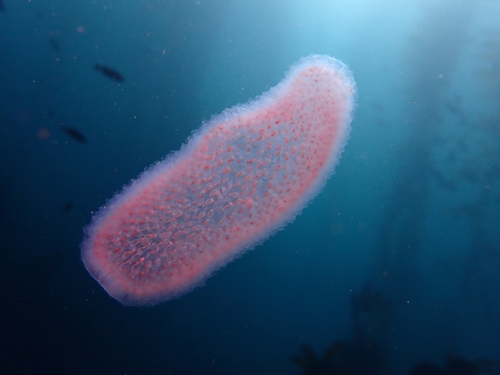
About Pyrosoma atlanticum Péron, 1804
Pyrosoma atlanticum colonies are cylindrical, and can reach up to 60 cm in length and 4 to 6 cm in width. Individual zooids that make up the colony form a rigid tube, which may be pale pink, yellowish, or bluish in color. One end of the tube is narrower and closed, while the other end is open and has a strong diaphragm. The outer gelatinous test is dimpled with backward-pointing, blunt processes. Individual zooids grow up to 8.5 mm long, and have a broad, rounded branchial sac with gill slits. An endostyle runs along the side of the branchial sac and produces mucus filters. Rhythmically pulsating cilia move water through the gill slits into the center of the cylinder. As the colony moves through the water, plankton and other food particles are trapped in these mucus filters. Pyrosoma atlanticum is bioluminescent, and produces a bright blue-green light when stimulated. This species occurs in temperate waters of all the world's oceans, most commonly between 50°N and 50°S. It is most abundant at depths greater than 250 m. Colonies are pelagic, moving through the water column, and perform large diurnal vertical migrations: they rise toward the surface in the evening and descend around dawn. Large colonies can travel up to 760 m vertically each day, and even small colonies a few millimeters long can move 90 m vertically daily. In its ecology, five specimens of the penaeid shrimp Funchalia have been recorded living inside P. atlanticum colonies. Other amphipods, including hyperiids of the genera Phronima and Phronimella, also live inside these colonies. Predators of P. atlanticum include several bony fishes: the spiky oreo, big-eyed cardinalfish, and pelagic butterfish, as well as dolphins, and whales such as the sperm whale and giant beaked whale.

