About Pyrorchis nigricans (R.Br.) D.L.Jones & M.A.Clem.
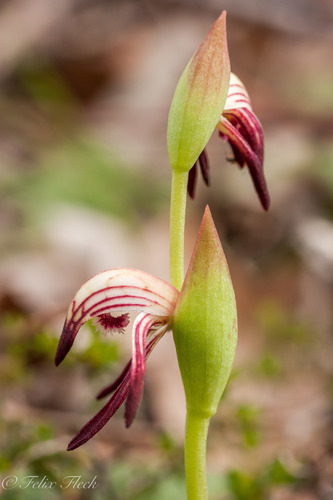
Pyrorchis nigricans is a terrestrial, perennial, deciduous herb that grows from an underground tuber. It produces a single dark green leaf with red markings; the leaf is roughly oval-shaped, measures 50–60 mm (2–2 inches) across, and lies flat against the ground. Between two and eight flowers grow on a thick, fleshy flowering spike that stands 50–300 mm (2–10 inches) tall. The flowers are a mix of reddish-purple and white, about 20–30 mm (0.8–1 inch) long and wide, with a large bract at the base of each flower. The dorsal sepal is light-coloured with reddish stripes, broadly lance-shaped, 20–25 mm (0.8–1 inch) long, and has edges that curve inwards. The lateral sepals and petals are linear-shaped, around the same size as the dorsal sepal, and spread out more widely. The labellum curves gently near its base, then curves sharply downwards near its tip; it is white with red lines, and its tip has a frilly edge. Flowering takes place from August to November, usually after a fire the previous summer.
This species, commonly called red beaks, grows in a range of habitats from heath to forest. It normally only flowers after a hot fire the previous summer, though some populations are known to flower without fire. In Western Australia, it occurs from Shark Bay to Israelite Bay, within the Avon Wheatbelt, Esperance Plains, Geraldton Sandplains, Jarrah Forest, Mallee, Swan Coastal Plain, Warren, and Yalgoo bioregions. It is common in southern and far western Victoria. In New South Wales, it grows in coastal districts south of Myall Lakes. It can also be found in south-eastern South Australia, Tasmania, and the larger Bass Strait islands.