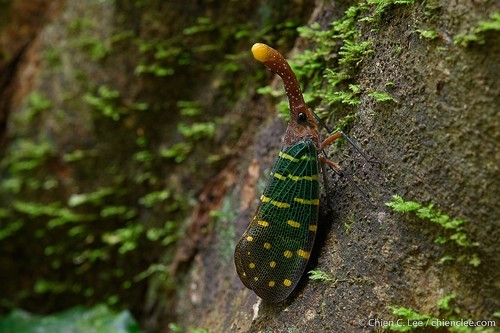
About Pyrops intricatus (Walker, 1857)
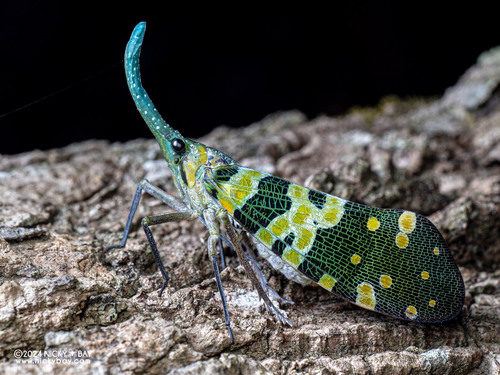
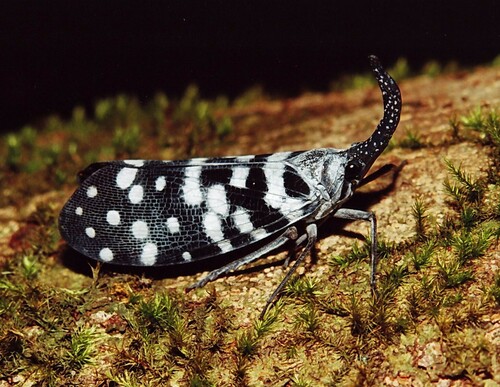
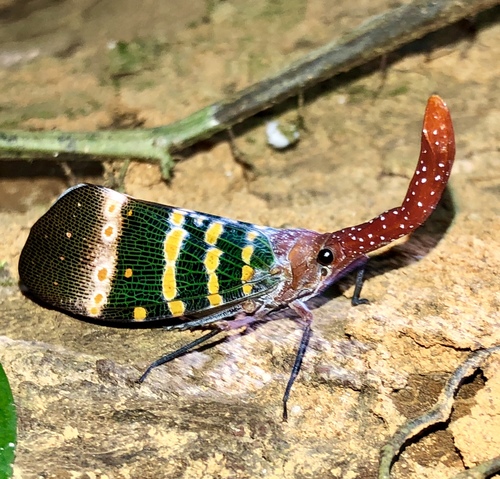
This species was originally described by Walker based on a male specimen. Walker's original description reads as follows: The entire insect is ferruginous. The rostrum is slightly curved, ascending, and covered in scattered white flecks. It is rounded and luteous at the tip, and is slightly shorter than the body. The abdomen is black, while the posterior edges of each abdominal segment are green. The tibiae and tarsi are black. The fore wings are black, marked with three testaceous bands located closer to the wing base, and twelve luteous spots on the outer portion of the wing. The third of these testaceous bands is interrupted. The wing veins are green, and are brighter in color on the inner portion of the fore wing than on the outer portion, where the vein arrangement differs. The hind wings are a bright bluish-green, with very broad purplish-black outer borders. The body length (excluding the rostrum) is 11 lines, and the wing length is 33 lines. This species is closely related to Hilda maculata (originally referenced as H. maculatus, Oliv.). In H. maculatus, the rostrum is entirely black and more slender at the tip; the fore wings have green spots and lack bands; and the blue-colored area of the hind wing extends further toward the border on the anterior side, and less far toward the border on the posterior side.