About Pyronia tithonus (Linnaeus, 1771)
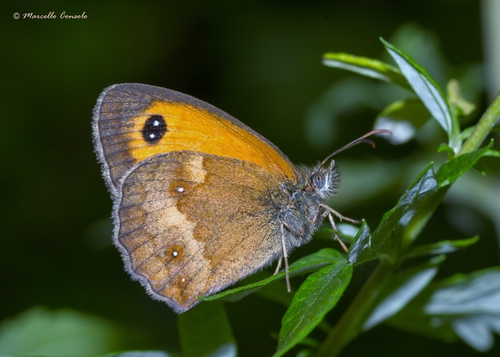
Pyronia tithonus, commonly called the gatekeeper or hedge brown, is a species of butterfly found across Europe. It prefers warmer weather, and climate is thought to limit the expansion of its range. Colony size depends on available habitat, and can range from just a few dozen to several thousand individual butterflies. It gets its common name "gatekeeper" from its consistent patrol of hedges and woodland rides, and it acts as an important pollinator. Caterpillars of this species feed primarily on fine grasses including fescues (Festuca) and bents (Agrostis), which grow commonly in meadows and roadside verges. As its common name suggests, the gatekeeper butterfly favors meadow margins and hedge habitats. Field gates are very often located in these types of areas, so gatekeepers are found much more frequently in these spots than similar species like the meadow brown. Gatekeeper butterflies produce one new generation each year. Adults emerge in July, reach their peak population in early August, and only a small number of adults remain by the end of the month. No specific courtship ritual has been documented for this species, but male scent spots most likely help attract mates. Males establish small territories and actively search for female mates. Copulation lasts approximately one hour, during which the paired butterflies stay stationary with their wings closed. Females lay between 100 and 200 eggs, usually in shaded areas, or sometimes lay eggs at random by ejecting them into the air. Newly developed larvae inside eggs are initially yellow, but quickly develop brown patches and continue to darken as they mature within the egg. Eggs hatch after around 14 days. Pyronia tithonus is a characteristic field-margin species. As larvae it feeds on grasses, and as adults it feeds on nectar. All Satyrinae larvae feed on grasses, including rough meadowgrass (Poa trivialis), smooth meadow grass (Poa pratensis), and sheep's fescue (Festuca ovina), and they are usually green or brown. The pupal stage is a thin, flimsy chrysalis that either hangs upside down or rests loose in grass. Adult gatekeepers are often found around blackberry plants. The adult butterfly has a short proboscis, and blackberry's shallow flowers make an ideal nectar source for the species. The confirmed primary larval food plants are multiple species of bents (Agrostis), fescues (Festuca), and meadow-grasses (Poa). Common couch (Elymus repens) is also used as a larval food plant.