About Pyromaia tuberculata (Lockington, 1877)
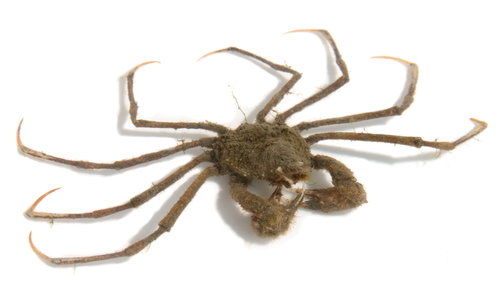
Pyromaia tuberculata (Lockington, 1877) is a benthic crab species, whose adults most often inhabit continental shelves. Individuals of this species have a granulate, tuberculate carapace, with a short, backward-facing spine on the first abdominal segment. This species goes through nine post-larval stages, each separated by short molting periods. Starting at the third crab stage, mature females can be distinguished from males by the large rounded gonopods that form their abdominal plates, which create a cavity to hold eggs. Adult specimens in the ninth crab stage can reach a maximum carapace length of 20 mm, and a maximum carapace width of approximately 18 mm.
This crab is native to the Pacific coast of North America, ranging from San Francisco Bay to Panama, but has spread to coastal waters of Argentina, Australia, Brazil, Japan, and New Zealand. Its larvae float freely in coastal and estuarine waters at depths of up to 18 meters. Adults live hidden among stones, or on mud to sandy-mud bottoms at depths reaching 412 meters. After being previously only observed in Atlantic coastal waters of Brazil, adults and larvae were later recorded on the Argentine Atlantic continental shelf. P. tuberculata has also spread to the western Pacific: specimens have been found along Australia’s southeast coast in Port Phillip Bay and Newcastle, and along Australia’s western coast in Cockburn Sound. In the northwest Pacific, populations of P. tuberculata became established in the waters of China and Japan, mostly as a result of naval shipping activity after World War II.
The life cycle of Pyromaia tuberculata has three main stages: egg, larval, and crab. The incubation period of P. tuberculata eggs has an inverse relationship with the water temperature where ovigerous females live: eggs hatch after 7 days at 26°C, and after 80 days at 8°C. Larvae are free-floating and feed on brine shrimp and small plankton, molting at regular intervals. Larval development includes two zoeal stages and one megalopa stage, which can be told apart by examining carapace spines and relative carapace width. In the first zoeal stage, the carapace has a single dorsal spine and the eyes are sessile, while the second zoeal stage has multiple small dorsal spines and slightly stalked eyes. In the megalopa stage, the carapace has no spines, but is larger and has more prominent lobes. After reaching the initial crab stage, P. tuberculata takes roughly 3 months to reach adulthood. There is no clear difference in body size or weight between adult males and females. Males become reproductively mature after 47 to 81 days, while females become able to reproduce after 62 to 79 days.