About Pyroderus scutatus (Shaw, 1792)
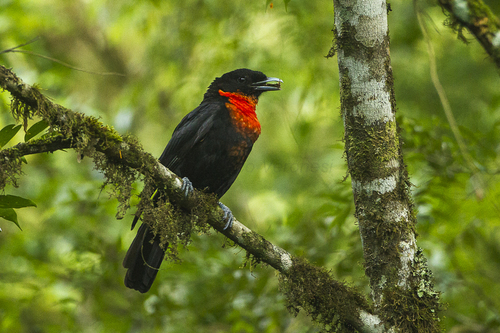
Pyroderus scutatus (Shaw, 1792) has a relatively heavy pale bluish bill, and primarily black plumage. It has a throat patch that ranges from dull brown to bright orange-crimson, depending on the subspecies, which makes it superficially resemble the smaller male purple-throated fruitcrow. Some subspecies also have brown underparts. Males gather in loose leks to call and attract females, which are smaller but otherwise similar in appearance to males. Multiple subspecies of Pyroderus scutatus are recognized. The nominate subspecies is Pyroderus scutatus scutatus, which has a glossy black back with some iridescence, a full crimson throat patch, dull chestnut color on some coverts, entirely black feet, and a light grey bill. Females of this subspecies are almost identical to males, but are slightly smaller and have a slightly duller ruff. Pyroderus scutatus orenocensis is more dull in coloration than P. s. scutatus, and has a fully chestnut breast. Pyroderus scutatus granadensis matches the appearance of P. s. scutatus, but is significantly smaller, measuring 14 inches in total length, 8.5 inches in wing length, and 5 inches in tail length. Pyroderus scutatus masoni is black on its upperparts, with dull dark brown or chestnut underparts that become mottled black near the undertail coverts. Its chin and chest are crimson, with a black stripe dividing the bright chest from the chestnut belly. Pyroderus scutatus occidentalis looks very similar to P. s. masoni, but its colors are brighter and more uniform, with an entire, non-mottled chestnut belly. The distribution of Pyroderus scutatus is highly disjunct, with separate populations in northeastern Venezuela and Guyana, the east Andean slopes of Peru, Andean slopes of northwestern Ecuador, Colombia and western Venezuela, the Venezuelan Coastal Range, and the Atlantic Forest of southeastern Brazil, eastern Paraguay and far northeastern Argentina. It inhabits humid forest, especially highland forests, but also occurs in forest borders, Amazon lowlands, and slightly drier forest. The largest population of P. s. scutatus occurs in the Atlantic Forest of southeastern Brazil; this high population is speculated to be caused by a lack of competition in the area. Other P. s. scutatus populations are found in eastern Paraguay and Misiones province in northeastern Argentina. Pyroderus scutatus orenocensis is only found in northeastern Bolívar State, eastern Venezuela. Pyroderus scutatus granadensis lives in the Andes of Colombia and Venezuela, specifically the eastern Andes, the eastern slope of the central Andes in Colombia, Serranía de Perijá, mountains east of Distrito Federal, and the Venezuelan Andes. Pyroderus scutatus masoni is found in the Andes of northern and central Peru, and has recently been confirmed in Cordillera del Cóndor in southeastern Ecuador. Pyroderus scutatus occidentalis occurs in the west Andes of Colombia, and the western slope of the central Andes of Colombia extending into northwestern Ecuador, specifically the provinces of Imbabura, Carchi, and Santo Domingo de los Tsachilas. Pyroderus scutatus is omnivorous, feeding on fruit, insects, and lizards, with fruit making up the majority of the adult diet. For the subspecies P. s. granadensis, nestling diet changes with age. When nestlings first begin eating, parents bring them mostly insects (66.7%) and lizards (25%), with fruit making up only 8.3% of the diet. Only in the late stages of the nestling period does the diet shift to become mainly fruit (82.4%), with insects making up the remaining 17.6%.