About Pyroderces apparitella (Walker, 1864)
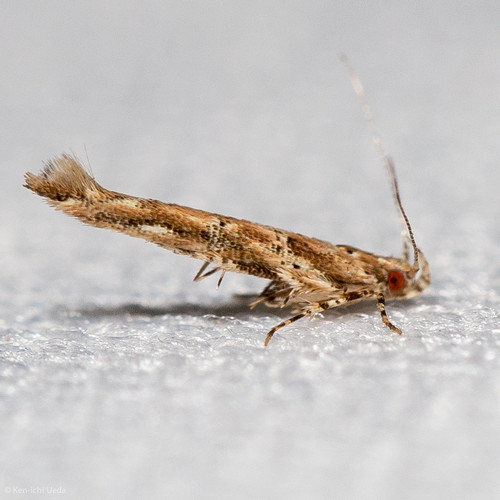
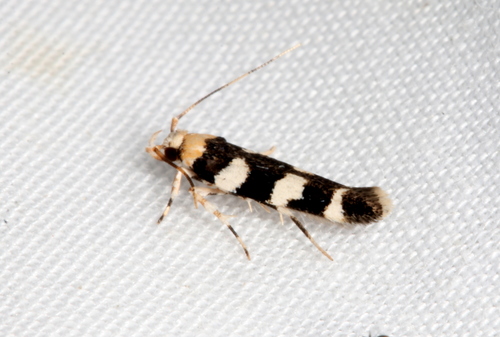
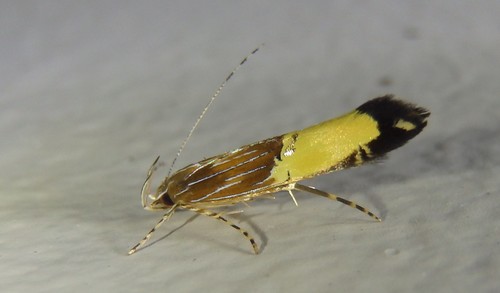
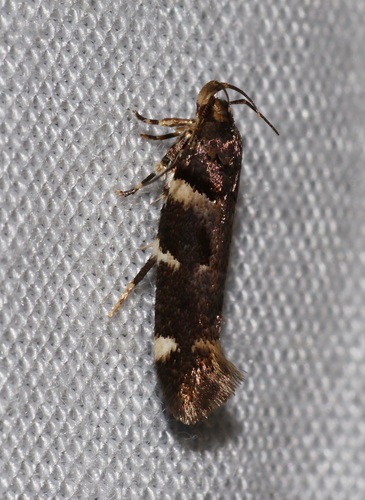
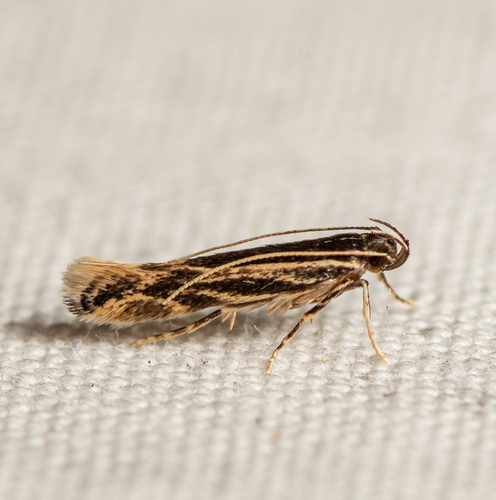
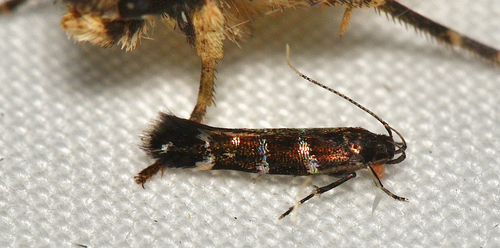
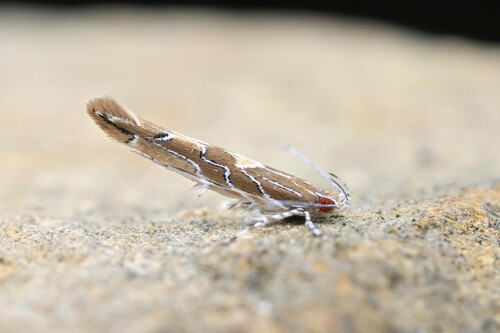
Pyroderces apparitella (Walker, 1864) was originally described by Walker as follows: it is a slender, gilded ochraceous moth. The front and underside of the head are silvery whitish. The palpi are smooth, very slender, and over three times longer than the breadth of the head; the third palpal joint is setiform, and as long as the second. The antennae are slender, silvery white, and shorter than the fore wings, with a black ring on each joint. The tibiae and tarsi bear gilded bands. On the fore wings, a silvery white line extends from the base toward a transverse, outwardly very acutely angular white line; there are two additional exterior oblique white lines that are black-bordered: the first forms two angles, the second forms an outwardly acute and very prominent angle. There are also two longitudinal subapical streaks: one is black, the other is white. The hind wings are cinereous-aeneous. The body length is 3 lines, and the wing length is 9 lines. This species is endemic to New Zealand, where it occurs in the North Island. It was observed in areas near Napier and Hastings in the early 1970s, and was considered uncommon at that time. It has also been recorded from North Auckland, but only rarely, and has been observed in Wellington. It inhabits native forests and residential gardens.