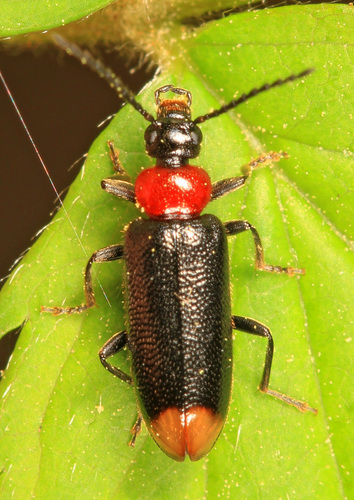
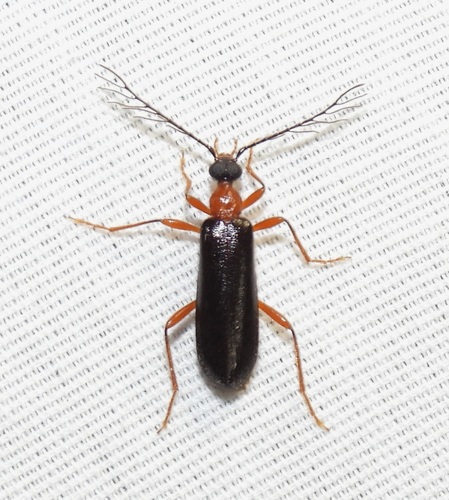
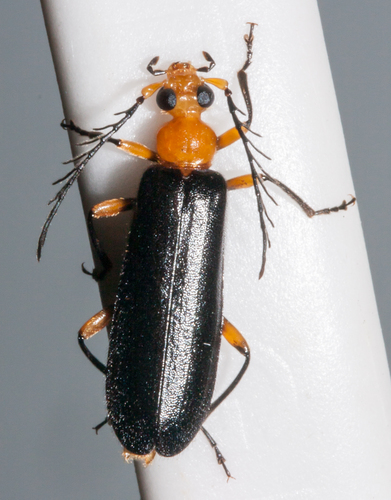
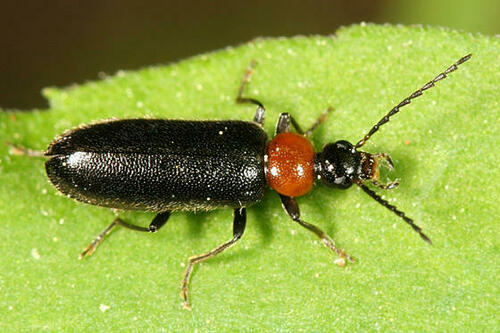
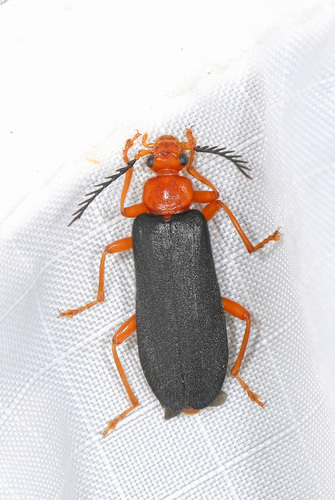
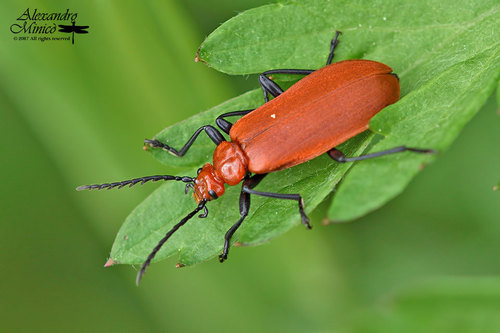
About Pyrochroa coccinea (Linnaeus, 1761)
Pyrochroa coccinea, commonly known as the Black-headed cardinal beetle, is a species of cardinal beetle in the family Pyrochroidae. It is found mainly in wooded areas and pastures throughout central Europe, including southern Great Britain. Like other ambrosia beetle species, early life stages of P. coccinea live and reproduce on wooden logs in the early stages of decomposition. Larvae develop over the course of multiple years, and overlapping generations often inhabit the same piece of wood. Adults, by contrast, are short-lived and only active during a brief season each year. They typically first appear in April, become more abundant in May and early June, and become very rare for the rest of the year. In Europe, Pyrochroa coccinea occurs primarily in central regions, with its range extending south to the Pyrenees, central Italy, and Greece; north to southern Scandinavia and the United Kingdom; and east to Ukraine, western Russia, and Kazakhstan. Within the United Kingdom, P. coccinea is widespread in southern England, and most common in southeastern regions. It occurs more locally and sporadically in northern regions toward the Lake District, and ranges well into the Welsh Border Counties. The species is less common in southwest England, as far north as southern Cumbria, and is generally absent from the West Country, western Wales, and Scotland. Pyrochroa coccinea is diurnal (active during the day). It inhabits wooded environments, found on vascular plants, under the bark of decaying broad-leaved timber, and on fallen logs. P. coccinea is less often found in more sun-exposed wooded areas, but its occurrence is not affected by microhabitat factors such as moisture or humidity within tree bark. This species also shows no clear preference for different tree species, and its presence is not affected by factors including log diameter, bark coverage, or the presence of fungi. This differs from many ambrosia beetle species, which live mutualistically in wooded habitats associated with a fungal food source. Because larvae take multiple years to fully mature, they require a habitat with abundant host resources. Larvae are present year-round, but fully developed larvae preferentially pupate in the spring. Because development takes multiple years, overlapping generations often live together in the same wooded area. Small larvae usually develop in narrower areas under bark, but bark slackens as larvae grow. This allows larger developing larvae to gather in groups in these more spacious, debris-filled areas. This characteristic of fallen timber also explains why females choose to lay eggs here: the bark stays solid initially to stably contain the eggs, and loosens later after eggs hatch and larvae begin to grow in size. After adults emerge from under tree bark, they stay confined to the host wood and often mate during this time. Adults eventually disperse by flight, and can be found on foliage within a short distance from their original log.