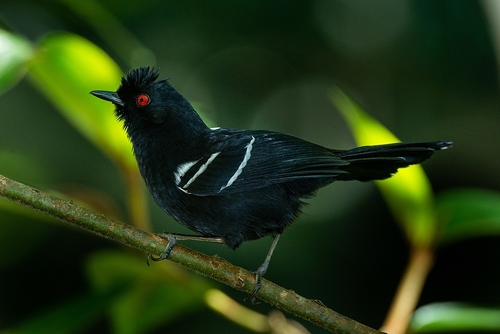
About Pyriglena leucoptera (Vieillot, 1818)
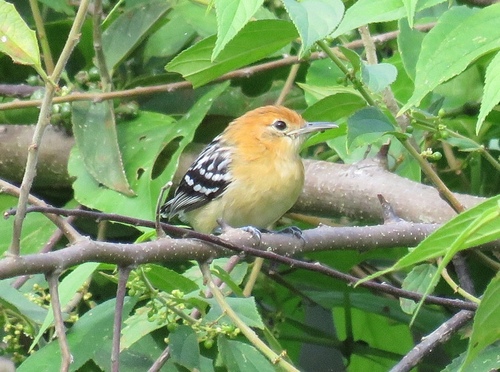
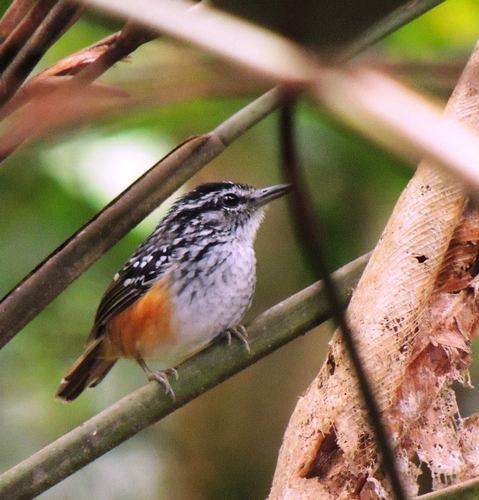
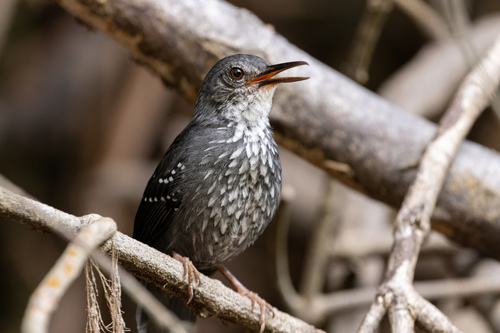
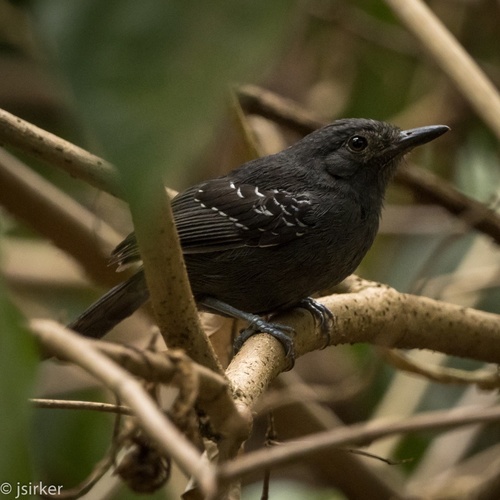
The white-shouldered fire-eye, scientifically named Pyriglena leucoptera (Vieillot, 1818), measures 16 to 18 cm (6.3 to 7.1 in) in length and weighs 25 to 34 g (0.88 to 1.2 oz). Adult individuals of both sexes have bright red irises. Males are mostly glossy black overall, with a white patch between their scapulars, white lesser wing coverts, and white tips on the median and greater wing coverts, while their underwing coverts are blackish gray. Females have yellowish brown to chestnut colored crown, upperparts, and wings, and do not have an interscapular patch. The female's tail is brownish black, its face is olive-tinged gray with black lores. Females have white chin and throat, light yellowish olive-brown breast, whiter olive-brown belly, and dark gray-tinged olive-brown flanks, crissum, and underwing coverts. The white-shouldered fire-eye is distributed across eastern Brazil, ranging from eastern Bahia and southwestern Minas Gerais south to Mato Grosso do Sul and extreme northern Rio Grande do Sul; it is also found in eastern Paraguay from Canindeyú to Itapúa, and in extreme northeastern Argentina's Misiones Province. This species inhabits dense understorey vegetation in lowland evergreen forest. It is most commonly found at primary forest edges, in mature secondary forest, and in clearings like those created by fallen trees. It can also be found in selectively logged forest and in plantations. It favors areas that hold dense thickets, vine tangles, and large stands of bamboo, and avoids sunlit areas such as open woodland with little undergrowth. In terms of elevation, it occurs from near sea level up to around 1,300 m (4,300 ft).