About Pyriglena leuconota maura (Ménétriés, 1835)
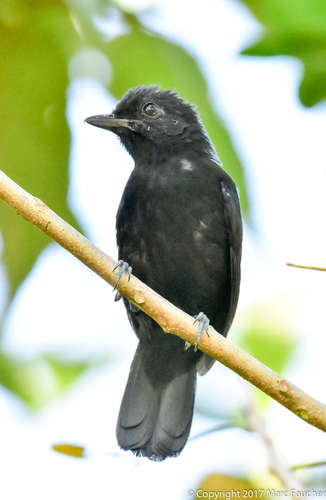
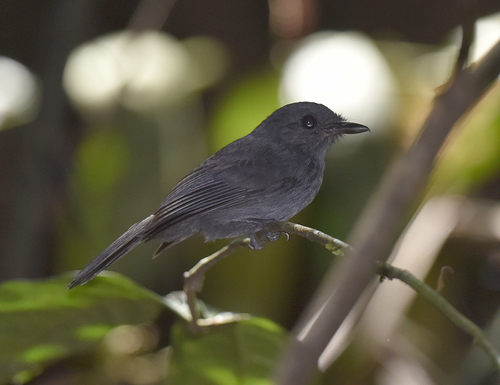
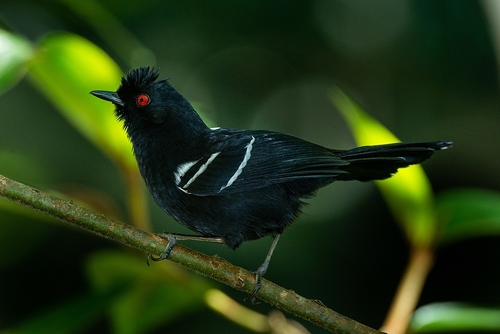
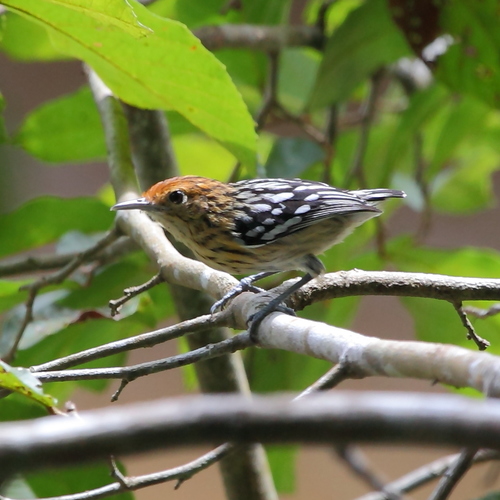
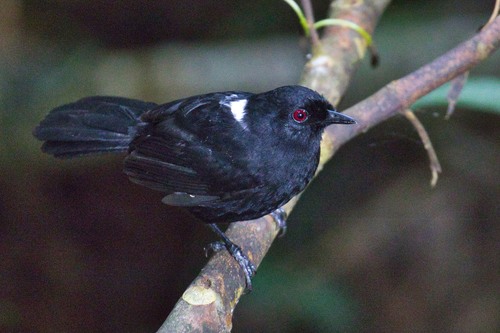
This subspecies, commonly called the Tapajos fire-eye or East Amazonian fire-eye, measures 16 to 18 cm (6.3 to 7.1 in) in length and weighs 26 to 36 g (0.92 to 1.3 oz), with apparent weight variation between the three subspecies. Both sexes have bright red irises. Males of all three subspecies are mostly glossy black, with a partially hidden white patch between their scapulars and blackish gray underwing coverts. Females of the nominate subspecies P. l. leuconota have dark reddish brown crown, upperparts, and wings, plus a partially hidden white interscapular patch. Their tail is brownish black, their face is brownish gray, their throat and breast are buff with a brownish tinge on the breast, and their sides, flanks, belly, and crissum are dark yellowish brown. Females of subspecies P. l. interposita are similar to the nominate but darker in coloration. Females of P. l. pernambucensis are also darker than the nominate, and have a longer tail. This taxon has a disjunct distribution across Brazil. Subspecies P. l. interposita occurs in the Amazon Basin south of the Amazon River, between the Xingu and Tocantins rivers in eastern Pará state. The nominate subspecies P. l. leuconota also occurs in the Amazon Basin south of the Amazon River, east of the Tocantins River in eastern Pará and northern Maranhão states. Subspecies P. l. pernambucensis is geographically separated from the other two subspecies, found in the eastern parts of Pernambuco and Alagoas states in northeastern Brazil. The species inhabits dense understorey vegetation in lowland and foothill evergreen forest. It occurs most often at primary forest edges, in mature secondary forest, and in clearings such as those created by fallen trees. It can be found up to 950 m (3,100 ft) in elevation.