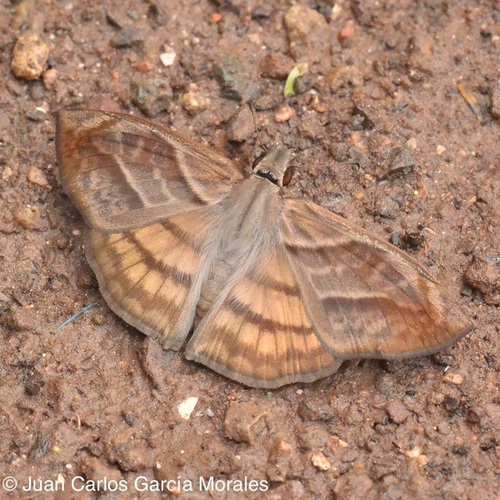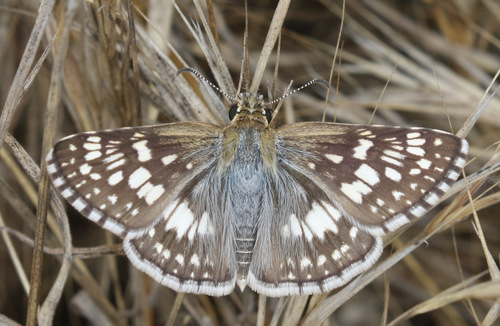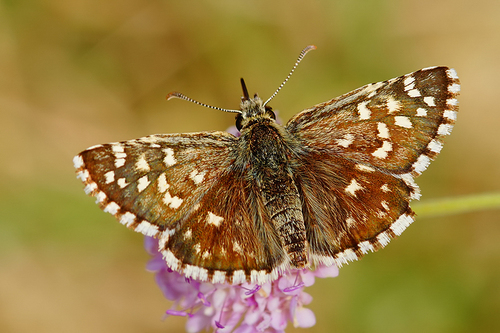
About Pyrgus malvoides (Elwes & Edwards, 1897)
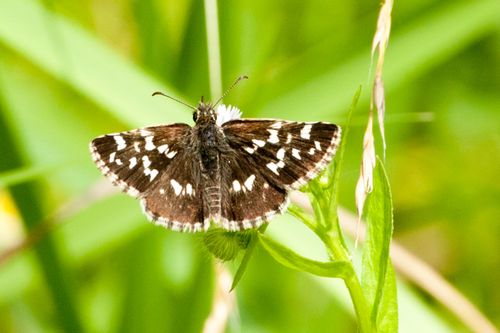
This butterfly has a wingspan of 24–26 mm. Pyrgus malvoides cannot be told apart from Pyrgus malvae by external physical characteristics, but it can be distinguished by its genital structures: markings match those of P. malvae, and the tergite of the male anal segment has a tooth on each side. Both P. malvoides and P. malvae can be clearly differentiated from other species in the genus Pyrgus by the presence of mostly distinct submarginal spots on the upper side of the wings. Pyrgus malvoides is distributed from Portugal and Spain, through southern and central France, southern Switzerland (south of the main Alpine ridge), and Austria (Vorarlberg, Tyrol), to Italy and Istria. Based on current knowledge, P. malvoides occupies a variety of fresh, and above all moist, habitats in the Alps, specifically those that have microclimate-favorable structures such as open ground on gravel and rocks, or disturbed ground from cattle trampling or erosion. No syntopic occurrence (living in the same geographic area) with P. malvae has been confirmed to date. Due to field identification challenges, no nectar host plants have been officially recorded, and it is assumed there are no major differences from P. malvae in this regard. The known altitudinal distribution ranges from 800 m to around 2000 m in Bavaria, and can reach up to 2500 m in the central Alps. Adult P. malvoides are on wing from April to September. In Bavaria, this species produces one generation that flies from approximately mid-May to mid-July. A second or even third annual generation, which has been recorded in areas such as Italy, has not been observed in Bavaria. Larvae feed on Potentilla, Agrimonia and Fragaria species, with a primary preference for Potentilla erecta. In Switzerland, caterpillars have been found on multiple cinquefoil species (Potentilla neumanniana [syn. tabernaemontani], Potentilla pusilla, Potentilla erecta) and have been recorded feeding on Fragaria vesca during breeding. Confirmed caterpillar host plants, with their regions of record, are: Potentilla tabernaemontani (syn. Potentilla neumanniana, Potentilla verna) [Switzerland, France], Potentilla pusilla [Switzerland, France, Italy], Potentilla erecta [Switzerland, Spain], Potentilla aurea [Austria], Potentilla reptans [France, Italy, Spain], Potentilla rupestris [Switzerland], Potentilla argentea [France], Potentilla grandiflora [Switzerland], Potentilla hirta [France], Potentilla pensylvanica [Spain], Potentilla recta [Spain], Fragaria vesca [Spain, Switzerland], Alchemilla hybrida [Switzerland], Agrimonia eupatoria [France, Spain], Filipendula vulgaris [Spain], Geum montanum [Spain], Rubus caesius [Spain], Rubus idaeus [Switzerland, France, Italy], Rubus ulmifolius [Spain], Sanguisorba minor [Switzerland, Spain]. This list of confirmed host plants draws primarily from combined data in Hernández-Roldán et al. (2012). The overall host plant range of P. malvoides is very similar to that of its sister species P. malvae, with only plants in the Rosaceae family used, and various Potentilla species the most common host. Caterpillars develop quite slowly, so they can still be found on their food plants in midsummer, often with multiple caterpillars on a single plant.