About Pyrgus fritillarius (Poda, 1761)
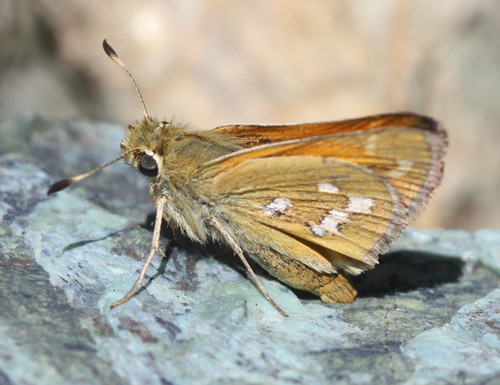
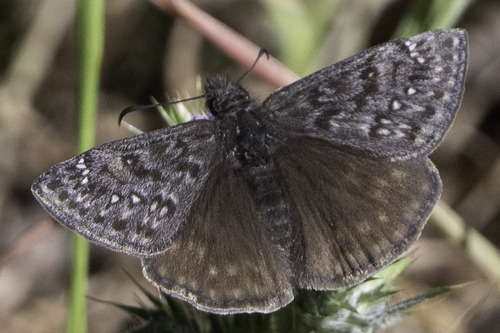
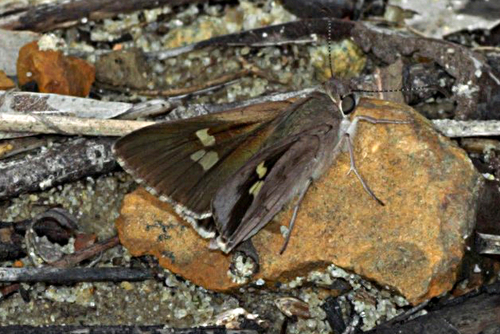
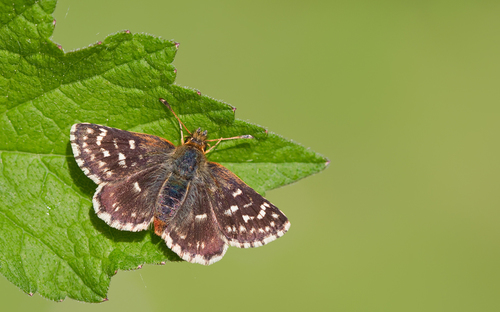
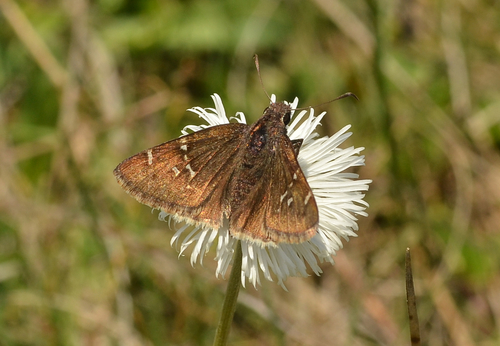
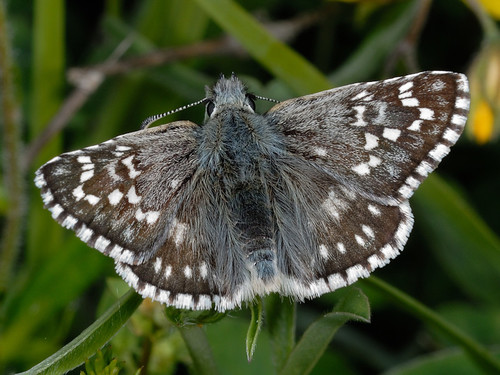
This species (Pyrgus fritillarius, also referred to as Pyrgus carthami) has a wingspan of 30–34 mm, with females averaging slightly larger than males. It is a typical member of the Pyrgus genus, and is the largest Pyrgus species found in Europe. The upperside of its wings is greyish-brown. On the upperside of the forewing, there is a basal grey and white fringe of hair, variable quadrangular white patches, and a cell spot shaped like the Greek capital letter sigma (Σ). The upperside of the hindwing has a submarginal line of white spots and a postdiscal line of oval whitish spots. The underside of the forewings is lighter, with a greenish-brown base color and white markings, while the hindwing underside has large brown and white patches bordered with dark grey, and a white submarginal area. The caterpillar is mainly olive-brown to beige, with a blackish chest. This species looks quite similar to Pyrgus alveus, Pyrgus armoricanus, Pyrgus serratulae, and Pyrgus malvae, and can be hard to distinguish from its close relatives. It is most often confused with the large grizzled skipper (P. alveus), as the two species often occur in similar habitats. It can usually be separated from P. carthami by the more closely grouped white spots on the forewing and a band of evenly sized pale spots in the postdiscal area of the hindwing. Pyrgus carthami ranges from the Iberian Peninsula to the Balkans and Central Europe, reaching a maximum latitude of 54 degrees in Central Europe. To the east, its distribution extends to the southern Urals and the northwestern Caucasus. It is not found in North Africa, peninsular Italy, northern France, the British Isles, or Scandinavia. The species occurs in dry, sunny slopes, clearings, meadows, and other grassy places, and its primary habitats are mostly dry grasslands. On the Mainfränkische Platten in Bavaria, this specifically refers to dry grasslands dominated by Carex humilis. These habitats are often located on sites with exposed rocks and gravel heaps in former shell limestone mining areas. In this natural region, rocky habitats are also found on corrugated limestone, in the Franconian Jura on Malm, and along dolomite rocks. Adult imagos remain mostly within or immediately adjacent to the larval habitat. This species produces one generation per year, and overwinters in the caterpillar stage. Adults are active on the wing from May to September. In Central Europe, the flight period runs from early May to mid-July, and rarely extends to early August. The annual flight period of any single population is much shorter, usually lasting only four weeks. Most observations of adult butterflies occur in June, with observation counts declining toward the end of the month. Typical egg-laying sites and caterpillar sites receive strong direct sunlight, and are not restricted to slopes facing south or west; they can also occur on flat ground. These sites have low plant cover, with high proportions of bare raw soil, rocks, or weathered gravel. Sparse vegetation sometimes only consists of individual cinquefoil cushions. Newly created embankments, such as those made from lime shards during road construction, are also used as larval habitat once the host plant becomes established. Multiple butterflies are rarely seen even in the best habitats. This is partly because the species has a fast flight and good camouflage when at rest, making it hard to spot, and partly because population densities are low even in optimal habitats. Although Pyrgus carthami is fairly common in some parts of its range, males exhibit perching behavior when searching for mates, and will reoccupy their territories after disturbance, though not always at the same perching spot. Males regularly fly over sparsely vegetated areas within their territory. To date, only Potentilla incana has been documented as a larval food plant in Bavaria. Additionally, oviposition has been observed on Potentilla verna agg. and Potentilla heptaphylla, which are also believed to be used as food plants. Across the species' full range, larvae also feed on Alcea, Malva sylvestris, Potentilla pedata, Potentilla neumanniana, Potentilla argentea, Althaea officinalis, Althea hirsuta, and Centaurea species. Egg-laying preferentially occurs on the underside of Potentilla incana leaves, which is confirmed in Bavaria for both of the species' main distribution areas: Main Franconia and the Middle Franconian Alb. In Main Franconia, pre-adult stages have only been found on this cinquefoil, which occurs in larger populations here. In the Middle Franconian Jura, Potentilla neumanniana and Potentilla heptaphylla are also used sporadically, and Potentilla incana occurs much less frequently and only locally in this region. In the Palatinate, eggs and caterpillars were also found on Potentilla neumanniana in an extremely xerothermic site. Overwintering most often occurs in the fourth and penultimate caterpillar instar, though this can vary depending on altitude. Pupation takes place in rolled host plant leaves or on the ground, and the pupal stage lasts up to 14 days. Caterpillars are easy to find in suitable sites, so the species can be readily detected by targeted larval searches in late summer. A characteristic bag-shaped shelter is built by caterpillars: first from a single leaflet, and later from multiple leaves. Caterpillars feed inside this shelter, which also provides good protection from solar radiation and predators. Adult imagos regularly visit flowers, and prefer to feed on yellow-flowering plants such as Hippocrepis comosa and Lotus corniculatus agg. In Bavaria, the species' altitude distribution ranges from approximately 170 m in Main Franconia to around 560 m in the Franconian Jura, which matches the altitude range where the species maintains its breeding habitats. A clear core distribution lies between 200 m and 400 m. Pyrgus carthami therefore has a narrow altitude range and is restricted to lower altitudes in Bavaria, though it can be found from sea level up to 1900 m in the southern part of its range.