About Pyrgus cacaliae (Rambur, 1839)
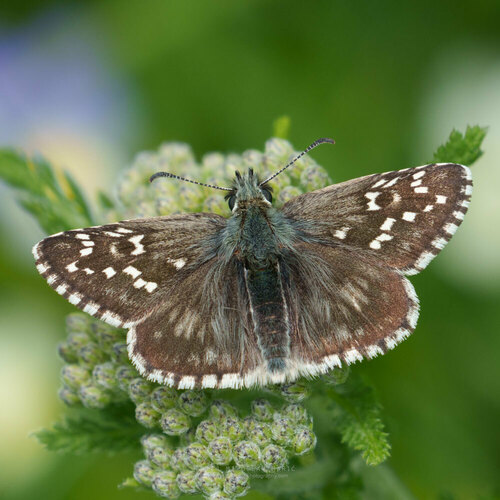
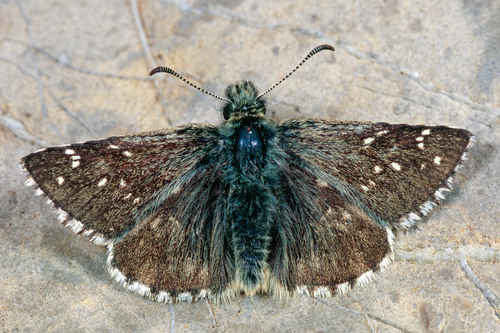
Pyrgus cacaliae is a relatively large skipper species, with greatly reduced white spots on the upper side of its forewing. The underside of its hindwing is a faded olive-green, and features a long and a short point on the inner edge that resembles an exclamation mark. This same marking is also found in Pyrgus andromedae, but in P. cacaliae it does not stand out as clearly against the surrounding surface. Compared to the Alpine grizzled skipper, which is typically found at lower altitudes, P. cacaliae can be distinguished by its smaller, fainter pale forewing markings and less bold markings on the underwing. A genital examination is required for reliable identification when there is uncertainty. Both sexes share the same marking pattern, but males are slightly darker in overall color. The caterpillar is usually dark, with a darker topline running along its back. When bred from eggs, clay-yellow caterpillars are often observed in the final two larval stages. The caterpillar's head shield is black. The pupa has bluish, frosted head and wing sheaths; the abdomen is brown at its base color, with only the segment boundaries lacking this blue frosting. The ventral side has a distinct pattern made up of a central black bar, with two black dots on each side of the bar. The dorsal side also has black dots and lines. The dorsal cremaster is red-brown. Pyrgus cacaliae is widespread across the Central Pyrenees, and spans from the western to eastern Alps, ranging through France, Italy, Switzerland, Germany, and Austria. It also occurs in the Balkans, specifically in the Dinaric Mountains of Bosnia-Herzegovina, the Central Carpathians of Romania, and the Rila, Pirin, and Stara Planina Mountains of Bulgaria. P. cacaliae occupies both humid habitats, including willow (transcribed from original 'rye') scrub along streams, peatlands, and springs, and dry alpine grasslands, which are most often interspersed with rock debris. In the Alps, its maximum distribution occurs between 1700 and 2500 meters above sea level, while in Bavaria the species has been recorded at altitudes from 1500 to 2300 meters. In the Bavarian Alps, the flight period runs from late June to early August. P. cacaliae can be observed in both even and odd years. According to observations from Switzerland and Austria, females lay eggs individually on the undersides of leaves of host plants, which include Potentilla erecta, Potentilla crantzii, and Potentilla aurea. In Switzerland, wintering has been observed in the penultimate caterpillar stage. Other observations note that caterpillars hatch after eleven days of egg development, feed only for a few days, then prepare for wintering. Observations from Austria's Rätikon and Silvretta areas indicate a two-year development cycle, with the first wintering in the first larval stage, and the second wintering in the final larval or pupal stage. Partial third hibernation means that adult imagos can be found every year.