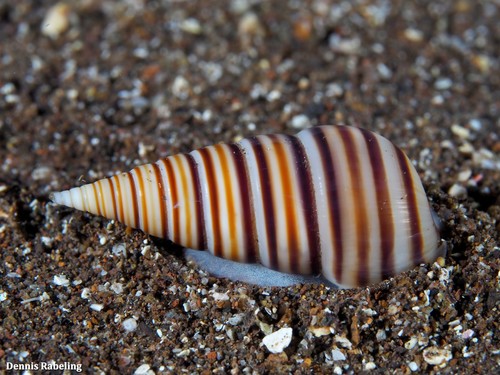
About Pyramidella dolabrata (Linnaeus, 1758)
Pyramidella dolabrata (Linnaeus, 1758) has shells that range in length between 14 mm and 36 mm, and the maximum recorded shell length is 36 mm. The shell of this species is white, conical, turreted, polished, elongated, and slightly transparent. Three or four narrow, transverse reddish or chestnut spiral lines sit on the body whorl, while there are two such lines on the whorls of the teleoconch. The middle band is always the narrowest; the other bands are wider and deeper in color. The pointed spire is made up of 10 to 12 distinct, smooth, slightly convex whorls. The body whorl is more inflated than the other whorls. The shell is smooth and umbilicated, with a small, narrow, deep, cylindrical umbilicus. The ovate aperture is subrotund at its base. It is generally marked on the inside by very prominent ridges, which in some specimens extend all the way to the edge of the sharp outer lip. The outer lip is often lirate internally. The columella is slightly arcuated, and recurved around the umbilicus. It has three folds at its base, and the upper fold is more prominent than the other two. This is a wide-ranging marine species, recorded from the Caribbean Sea, Gulf of Mexico, Lesser Antilles; the Atlantic Ocean off Cape Verdes, St. Helena, São Tomé and Príncipe, Angola, West Africa; the Indian Ocean off Madagascar and Mauritius; and the Indo-Pacific Region. The minimum recorded depth this species has been found at is 0 m, and the maximum recorded depth is 57 m.

