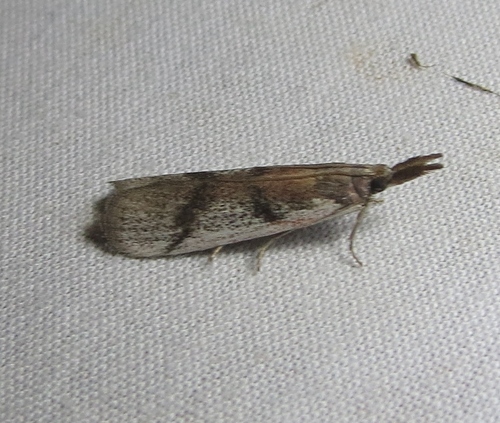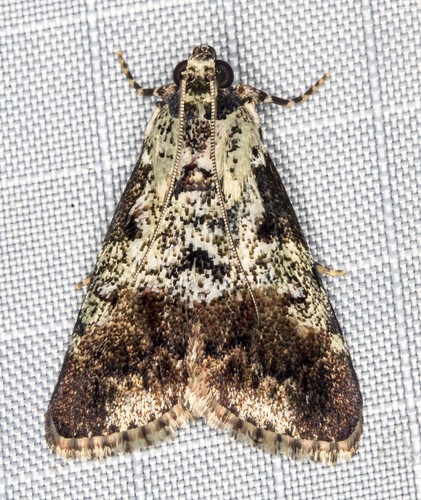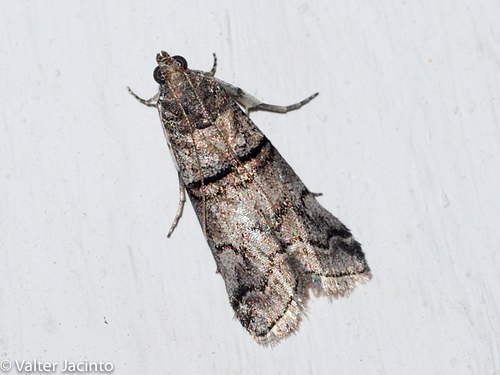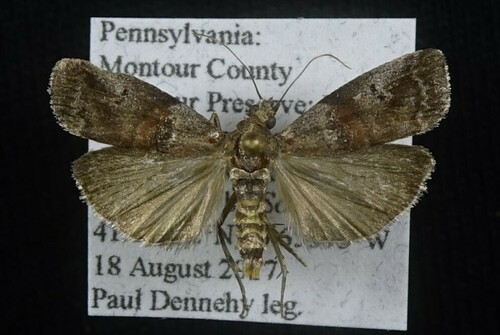
About Pyralis pictalis (Curtis, 1834)
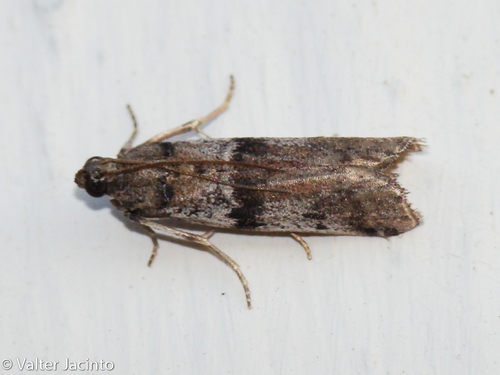
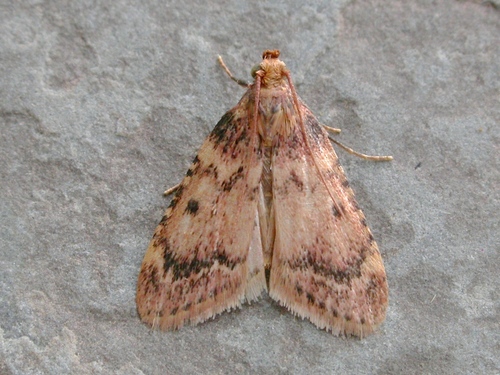
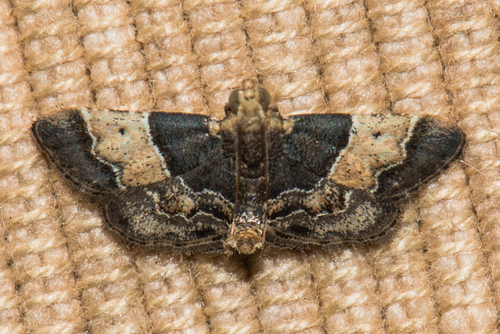
Description and ecology: Adult Pyralis pictalis resemble the meal moth P. farinalis, but are smaller with a wingspan ranging from 15 to 34 mm. Compared to P. farinalis, the base of Pyralis pictalis's forewings has a lead-grey hue, and the light-bordered band at the center of the forewing is narrower. The larvae of this moth have been recorded eating the eggs of the tropical bed bug Cimex hemipterus, a major vector of hepatitis B. This relationship must be taken into account when eradicating P. pictalis in pest situations, particularly because C. hemipterus rapidly evolves insecticide resistance. Biological pest control targeting bed bugs using P. pictalis may be feasible if the moth's status as a stored-food pest is properly managed. Based on available data, the insectivorous feeding behavior of P. pictalis caterpillars may be a seasonal phenomenon. This means that if used for biological control, the caterpillars would need to be released in large numbers for several weeks at the start of the wettest season, and the resulting adult moth population would need to be immediately suppressed or sterilized. Distribution: The exact origin of this moth is unknown, but it is believed to originate from the general Southeast Asian region. Its native range is presumed to extend from southern India and Sri Lanka northeast to Japan, and southeast at least to Sumatra, Java and parts of Borneo. Its natural range may reach as far east as the Philippines, and as far southeast as New Guinea or even Fiji. However, the apparently isolated population in Fiji may be an introduction from the colonial era, just like the recorded populations in Australia (outside the core range beyond Wallacea) and northwest British India (outside the native range beyond the Himalayas). In Polynesia beyond Fiji, P. pictalis has been recorded in Kiribati and Hiva Oa in the Marquesas Islands; these are also presumed to be fairly recent introductions. In Africa, the species has not been found in eastern parts of the continent, but has been recorded in Belgian Congo, West Africa, and South Africa. There are also confirmed records of P. pictalis in England and other localities across Europe. Outside of its contiguous native range, this moth occurs mainly along the historical East Indiaman trade route. Outside its presumed core range, P. pictalis generally only occurs ephemerally. For example, the species has not established a self-sustaining population in temperate and even subtropical Europe, and can be considered effectively absent from the region for most practical purposes.