About Pyracantha crenulata (D.Don) M.Roem.
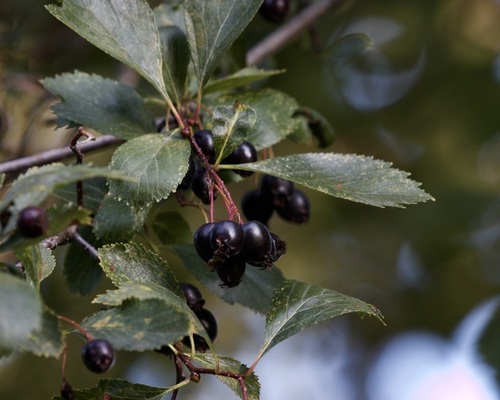
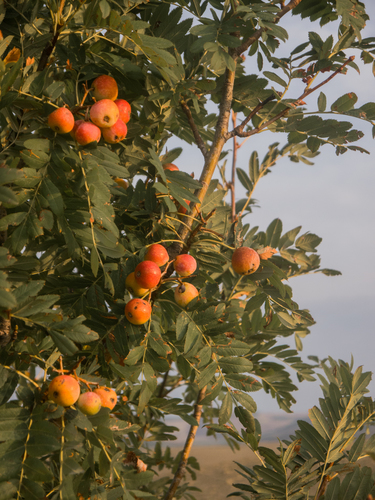
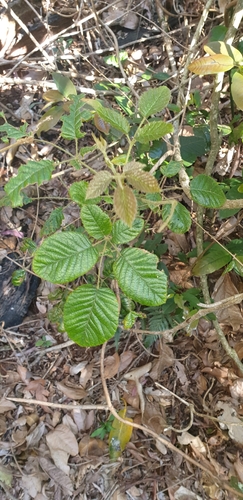
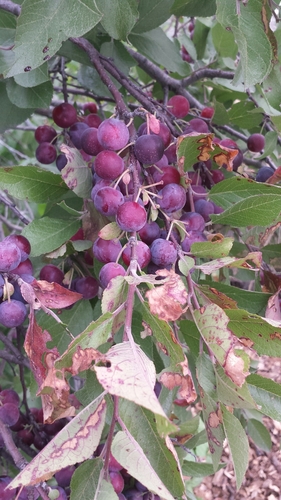
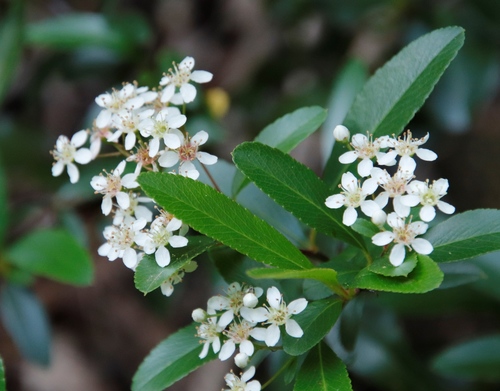
Pyracantha crenulata (D.Don) M.Roem. is a deciduous bushy shrub that is profusely branched and very thorny. It reaches a mature height of 2.4–3.0 m (7 ft 10.5 in – 9 ft 10.1 in). Mature plants develop dark brown, glabrous (hairless) stem bark. Its leaves are dark green, smooth on the exterior, 2.5–4.0 cm (1.0–1.6 in) long and 1.0–2.2 cm (0.4–0.9 in) wide, with a tapering tip. This species flowers between April and May. Its flowers are hermaphrodite (bisexual), arranged in white compound corymb inflorescences made of many individual flowers. Each flower has five sepals, five petals, 20 stamens, and one central ovary. Fruits ripen between June and September, forming small orange-red to dark red berry-like structures that weigh around 250 mg each. Most berries hold five triangular, brown seeds, though some contain three or four; all seeds are covered by a hard seed coat. This species is native to Assam, China, the East and West Himalayas, India, Myanmar, Nepal, Pakistan, Tibet, and Vietnam. It has been introduced to the United States (Alabama, California, Florida, Georgia, Louisiana, North Carolina, Oregon, South Carolina, Texas, and Washington), South America (northeastern Argentina and Guatemala), Europe (Spain), South Africa (Free State, Lesotho, and the Northern Provinces), Australia (New South Wales), and both the North and South islands of New Zealand. Pyracantha crenulata grows in barren, rocky, dry grasslands, along stream and tributary banks, in shrubberies, on open slopes, in cultivated areas, and along roadsides. In the Himalayan hills of Uttarakhand, it grows between 900–1,200 m (3,000–3,900 ft) above sea level within Pine and Quercus forests (Osmastan 1926). This species is cultivated as an ornamental plant. Its leaves are used to make herbal tea, and its wood can be used to craft walking sticks. Its orange-red pomes serve as food for birds. In the Himalayas, the plant is harvested from wild forests for use in herbal medicine, where it is prepared as decoctions of dried fruits, liquid extracts, and tinctures. P. crenulata is used to treat heart failure, cardiac issues, and hypertension. When eaten with yogurt, its berries help patients recover from dysentery (Singh et al. 2012). In the Himalayas, it is also planted along the borders of agricultural fields: its extensive roots make it an effective soil binder that reduces monsoon soil erosion, and its dense thorny growth blocks wild animals from entering vegetable and cereal crop fields.