About Pylodictis olivaris (Rafinesque, 1818)
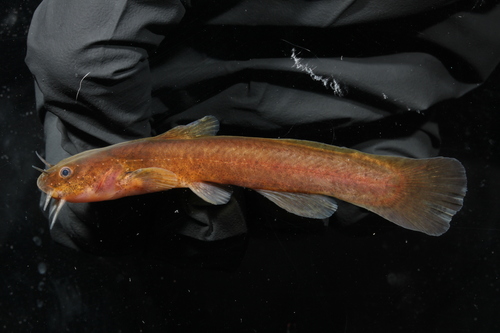
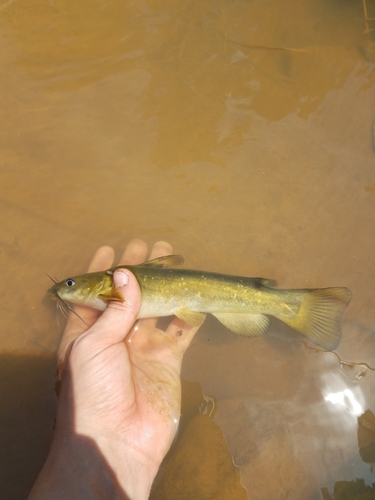
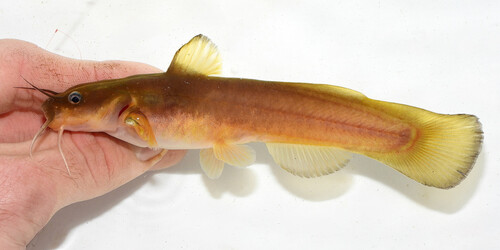
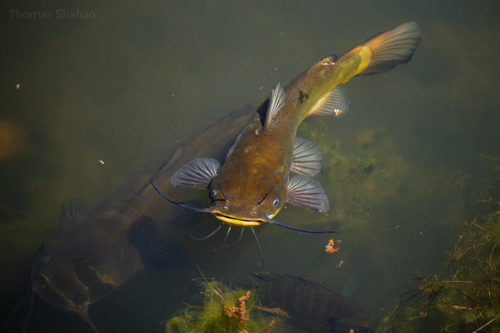
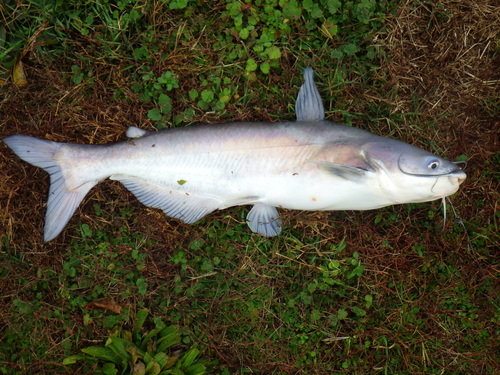
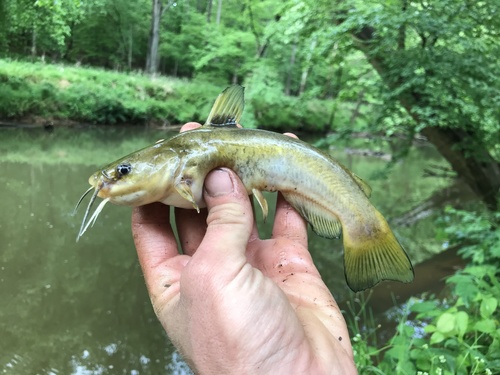
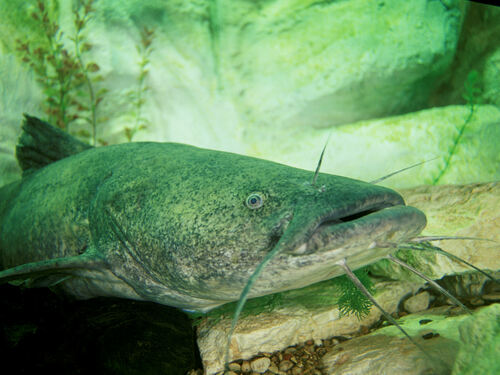
Flathead catfish, scientifically named Pylodictis olivaris (Rafinesque, 1818), have olive-colored sides and dorsal areas, with an underside that ranges from white to yellow. Individuals, especially young specimens from clearer water, often have strong mottling in dark brown to black shades. Their eyes are small, and their lower jaw extends noticeably past the upper jaw. The premaxillary tooth pad has posterior extensions. The caudal fin has an emarginate structure, and its upper lobe may have a distinct isolated white margin. All other fins are brown, though the body's mottling can extend onto the fins. The anal fin has 14 to 17 rays and a rounded margin. This species can grow up to 155 cm (61 in) in length and reach a maximum weight of 55.79 kg (123.0 lb), making it the second-largest North American catfish, outranked only by the blue catfish (Ictalurus furcatus). Most adult flathead catfish reach an adult length between 15 and 45 inches (38–114 cm). The maximum recorded lifespan for this species is 28 years. Individuals reach reproductive maturity between 4 and 5 years of age, when they reach a length of approximately 18 inches (46 cm). The current world angling record for this species was caught on May 19, 1998, from Elk City Reservoir, Kansas, and weighed 55.79 kg (123.0 lb). A 1982 record from a specimen caught via "other methods" reports an individual caught from the Arkansas River that measured 175 cm (69 in) and weighed 63.45 kg (139 lb 14 oz), which would make the flathead catfish the longest catfish species in North America. The native range of the flathead catfish covers a broad area west of the Appalachian Mountains, including the large rivers of the Mississippi, Missouri, and Ohio basins. Its range extends north into Canada, west to Texas, and south to the Gulf of Mexico, including northeastern Mexico. While flathead catfish cannot survive in full-strength seawater (which has a salinity of approximately 35 parts per thousand, or 35 grams of salt per liter of water), they can survive in water with a salinity of 10 ppt for short periods, and thrive in salinities up to around 5 ppt. Flathead catfish are a benthic species, meaning they prefer to stay on the bottom of bodies of water. They favor medium to large rivers with relatively warm water and stable, slow-moving currents. They prefer habitats with vertical banks (where the land bank slightly overhangs the water) and areas that contain fallen trees or other woody debris. For cover, they specifically prefer woody debris located in water at least 3 metres (9.8 ft) deep, with individual pieces of debris measuring at least 3 metres (9.8 ft) in diameter. Most flathead catfish have a home range smaller than 2 kilometres (1.2 mi), so this is a non-migratory fish species.