About Pygoscelis papua (J.R.Forster, 1781)
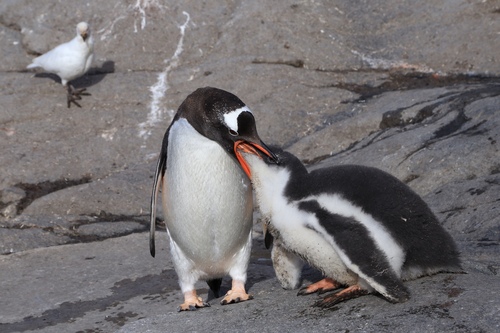
The gentoo penguin (scientific name Pygoscelis papua, published by J.R.Forster in 1781) is easily recognized by the broad white stripe that extends like a bonnet across the top of its head, along with its bright orange-red bill. It has pale whitish-pink webbed feet and a relatively long tail, which is the most prominent tail of all penguin species. Gentoo penguin chicks have grey backs and white fronts. As the penguin waddles along on land, its tail sticks out behind and sweeps from side to side; this movement gives the genus its name Pygoscelis, which means "rump-tailed".
Gentoo penguins reach a total length of 70 to 90 cm (28 to 35 in), making them the third-largest penguin species, after the emperor penguin and the king penguin. Males reach a maximum weight of around 8.5 kg (19 lb) just before moulting, and a minimum weight of about 4.9 kg (11 lb) just before mating. For females, maximum weight reaches 8.2 kg (18 lb) just before moulting, but their weight drops to as little as 4.5 kg (9.9 lb) while guarding chicks in the nest. On average, gentoo penguins from northern populations are 700 g (1.5 lb) heavier and 10 cm (3.9 in) longer than southern individuals. Southern gentoo penguins reach 75–80 cm (30–31 in) in length.
Gentoo penguins are the fastest underwater swimmers of all penguin species, able to reach speeds up to 36 km/h (22 mph). They are well adapted to frigid, harsh climates.