About Pygoscelis antarcticus (J.R.Forster, 1781)
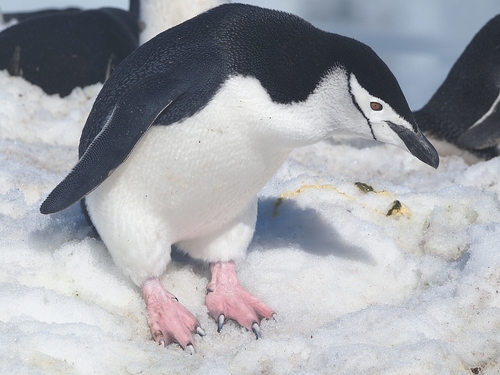
Pygoscelis antarcticus (J.R.Forster, 1781), commonly called the chinstrap penguin, reaches 68–76 cm (27–30 in) in length and weighs 3.2–5.3 kg (7.1–11.7 lb), with body size varying by time of year. Males are larger in both weight and height than females. Adult chinstrap penguins have black flippers with white edges, and the inner sides of their flippers are white. Their white face extends behind their reddish-brown eyes; the chin and throat are also white, while the short bill is black. Their strong legs and webbed feet are pink. The species’ short, stumpy legs create a distinct waddle when walking. Chinstrap penguins have black backs and white undersides, which provides countershading camouflage when viewed from above or below, helping them avoid detection by predators. Chinstrap penguins have a circumpolar distribution. They breed in Antarctica, Argentina, Bouvet Island, Chile, the French Southern Territories, and South Georgia and the South Sandwich Islands. Vagrant individual penguins have been found in New Zealand, Saint Helena, Tristan da Cunha, and South Africa. The diet of chinstrap penguins is made up of small fish, krill, shrimp, and squid. Each day, they swim up to 80 km (50 mi) offshore to find this food. The species’ tightly packed feathers form a waterproof coat, which lets them swim in freezing waters. Thick blubber deposits and specialized blood vessels in the flippers and legs also help retain body heat. The main predator of chinstrap penguins at sea is the leopard seal (Hydrurga leptonyx), which causes a 5% to 20% decrease in the chinstrap penguin population each year. On land, the primary predators are the brown skua (Stercorarius antarcticus), south polar skua (Stercorarius maccormicki), and southern giant petrel (Macronectes giganteus). These three species most commonly prey on chinstrap penguin eggs and young. Antarctic fur seals are also known to occasionally kill chinstrap penguins.