About Pygoscelis adeliae (Hombron & Jacquinot, 1841)
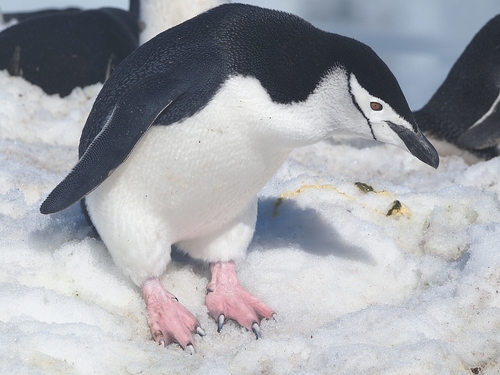
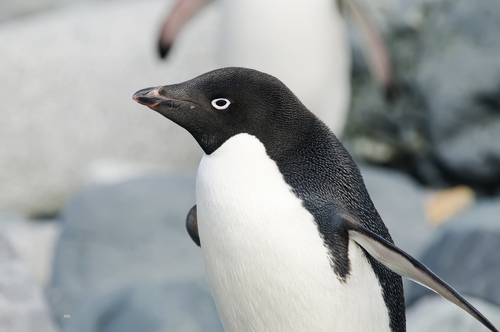
Pygoscelis adeliae, commonly known as the Adélie penguin, is a mid-sized penguin species. Adults measure 70–73 cm (28–29 in) in length and weigh 3.8 to 8.2 kg (8.4 to 18.1 lb). While males and females have identical appearance, females have shorter wings, shorter beaks, and are significantly lighter in weight. Adult Adélie penguins have black coloration on the head, throat, and upper body, with bright snowy white underparts. They have a distinct white eye ring surrounding a black iris. Most of the beak is covered by black feathers, with only the tip exposed; the exposed tip is primarily black, though it may have faint, indistinct reddish-brown markings. The upper surface of the wing is black with a white trailing edge, while the underside is white with a narrow black leading edge and a small black tip. Most of their unfeathered legs and feet are pinkish. When newly hatched, Adélie penguin chicks are fully covered in down. This initial down coat is typically silvery-grey, darker on the head, though some chicks are much darker across their whole body. Within 10 days of hatching, chicks moult into a second set of down feathers that is entirely dark smoky-grey. After a third moult, which occurs 7–9 weeks after hatching, immature Adélie penguins resemble adults, though they tend to be smaller, have a bluer tinge on their upperparts, and have white rather than black chins and throats. They do not develop a full adult white eye ring until they are at least one year old. The Adélie penguin is a truly Antarctic species, and one of only four penguin species that nest on the Antarctic continent itself. Breeding colonies are spread along Antarctica's coasts and on multiple sub-Antarctic islands, including the South Orkney Islands, South Shetland Islands, South Sandwich Islands, Balleny Islands, Scott Island, and South Georgia. The species is far less common north of the 60th parallel south, but individual vagrants have been recorded in Australia, New Zealand, and southern South America. During the breeding season, Adélie penguins require bare, rocky ground to build their nests. They will not nest on ice, and preferentially select areas where wind, sun angle, or both prevent snow drifts from accumulating. At the start of the breeding season, colony sites may be up to 100 km (62 mi) from open water, but this distance decreases as summer advances and pack ice breaks up. After breeding is complete, adult Adélie penguins usually move to ice floes or ice shelves to moult, though some stay onshore. During winter, the birds remain within the pack ice zone; most move north to areas that have visible light for at least part of the day, generally north of roughly 73°S. Some individuals stay near their breeding colonies, while others travel hundreds or thousands of kilometers away. As long as there are breaks in the pack ice, Adélie penguins can survive hundreds of kilometers south of open water, and they have been recorded foraging in winter in areas with up to 80% pack ice cover. Apsley Cherry-Garrard, a survivor of Robert Falcon Scott's ill-fated 1910 British Antarctic Expedition, documented details of Adélie penguin behaviour in his book *The Worst Journey in the World*, noting that the penguins are extraordinarily like children, like little people of the Antarctic world full of their own importance. George Murray Levick, a Royal Navy surgeon-lieutenant and scientist who also accompanied Scott, observed displays of selfishness among the penguins during his Antarctic survey work. He described how crowds of penguins would stand at the edge of an ice terrace leading to the water, and after pushing one penguin into the water first, all would crane their necks to check that the pioneer was safe before following the first penguin in. Levick also recorded detailed observations of Adélie penguin mating habits. One member of Scott's expedition observed that the penguins' curiosity could put them in danger, which was a particular nuisance for Scott. The main problem for the expedition's dog teams came from the foolish behaviour of penguins: groups would repeatedly leap onto the expedition's ice floe, immediately showing overwhelming curiosity and stubborn disregard for their own safety. They waddled forward, poking their heads back and forth in their characteristic absurd manner, even when a line of howling dogs strained to reach them. They appeared unafraid, stepping closer even as the dogs rushed as far as their harnesses or leashes allowed, not daunted in the least, raising their ruffs and squawking in apparent anger. Eventually, the penguins would step close enough for the dogs to reach them, resulting in the penguin's death. Other members of the South Pole expedition were more receptive to the Adélie penguin's curious nature. Cherry-Garrard recounted that when Meares and Dimitri exercised dog teams on large ice floes during periods when the expedition was stopped, a penguin once spotted the team and hurried toward them from far away. As the penguin got closer, the dogs became frantically excited, but the penguin interpreted their barking and straining at the ropes as a greeting, and hurried faster to meet them. The penguin became extremely angry at a man who stepped in to save it from being killed, clinging to the man's trousers with its beak and beating his shins furiously with its flippers. Cherry-Garrard noted that it was not uncommon to see a small Adélie penguin standing within inches of the nose of a dog frantic to attack it. Cherry-Garrard held great regard for the birds, writing that whatever an Adélie penguin does has individuality, it lays its whole life out for all to see, it cannot fly away, and because it is quaint in all its actions and fights against bigger odds than any other bird with constant gallant pluck, it is considered something apart from ordinary birds. Despite their mid-sized stature, Adélie penguins are known for a bold, boisterous personality, and will challenge other animals, including predators far larger than themselves. Footage for the 2018 BBC Earth documentary *Spy in the Snow* highlighted this boisterous behaviour when an individual Adélie penguin arrived to defend a group of emperor penguin chicks threatened by a Southern giant petrel (Macronectes giganteus). Despite being a different species from the emperor penguin chicks, the Adélie charged the petrel, then positioned itself between the predator and the chicks until the petrel retreated. Adélie penguins usually swim at around 5 miles per hour (8.0 km/h), and can leap up to 3 metres (10 ft) out of the water to land on rocks or ice. During the chick-rearing season, Adélie penguins feed mainly on Antarctic krill, ice krill, Antarctic silverfish, Antarctic lanternfish, the amphipods Themisto gaudichaudii, Cyllopus lucassi, Hyperia, and unidentified gammariids, sea krill, glacial squid, and other cephalopods; their diet varies by geographic location. A stable isotope analysis of fossil eggshell accumulated in colonies over the last 38,000 years shows that a sudden shift from a fish-based diet to a krill-based diet began around 200 years ago. This change is most likely due to the decline of the Antarctic fur seal starting in the late 18th century and baleen whales in the early 20th century. The reduction in competition from these predators led to a surplus of krill, which Adélie penguins now use as an easier food source. Jellyfish from the genera Chrysaora and Cyanea are actively hunted food items for Adélie penguins; previously, scientists thought these jellyfish were only eaten accidentally. Similar active preferences for jellyfish have been found in little penguins, yellow-eyed penguins, and Magellanic penguins.