About Pygoplites diacanthus (Boddaert, 1772)
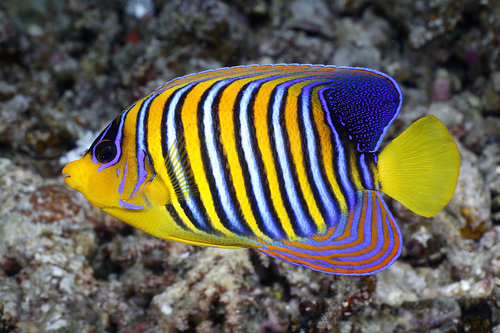
The royal angelfish, scientifically named Pygoplites diacanthus (Boddaert, 1772), has a moderately elongate, very compressed body. Its preorbital bone is convex and lacks strong spines, while the preopercle has one prominent angled spine. The ventral edge of the interopercle is smooth. The royal angelfish has moderately small eyes and a terminal, protractile mouth. It reaches a maximum total length of 25.0 cm (9.8 in). It has 14 dorsal spines, 17 to 19 soft dorsal rays, 3 anal spines, 17 to 19 soft anal rays, and 16 to 17 pectoral fin rays. Its caudal fin is rounded. Exact coloration varies by region, with particularly distinct differences in populations from the Indian Ocean, Red Sea, and South Pacific Ocean. A consistent pattern across all variants is a body marked with narrow blue-white and orange stripes that angle backward. The posterior section of the dorsal fin is black or blue with closely spaced blue dots, while the posterior section of the anal fin has alternating yellow and blue bands that run parallel to the body contour. The caudal fin is yellow. Juveniles have a large dark spot on the basal portion of the soft dorsal fin. This species has a reported maximum lifespan of 15 years. Recent research shows that the genus Pygoplites contains two morphs of this species, and the two variants may hybridize at Christmas Island. The royal angelfish is widely distributed across the Indo-Pacific. Its range covers the Red Sea and Indian Ocean from East Africa to the Maldives, extending east to the Tuamoto Islands, New Caledonia, and the Great Barrier Reef. The northern edge of its range reaches the southern East China Sea around Taiwan, as well as the Ryukyu Islands and Ogasawara Islands of Japan. This angelfish is found at depths between 0 and 80 m (0 to 262 ft), in coral-rich areas of lagoons and reefs, and is also frequently encountered near caves. It is a carnivorous species that feeds on sponges and tunicates growing on reefs and in underwater caves. It is non-migratory, and can occur alone, in pairs, or in groups. Juveniles typically shelter in cracks and crevices. Royal angelfish reproduce through spawning, which usually takes place at dusk or night. Before releasing eggs and sperm into the upper water column, spawning individuals perform a spiraling courtship dance. The royal angelfish is harmless to humans. It has minor commercial use in the aquarium trade, and is valued by aquarium hobbyists as one of the few "reef safe" angelfish. This is because its diet consists primarily of sponges, and does not include corals.