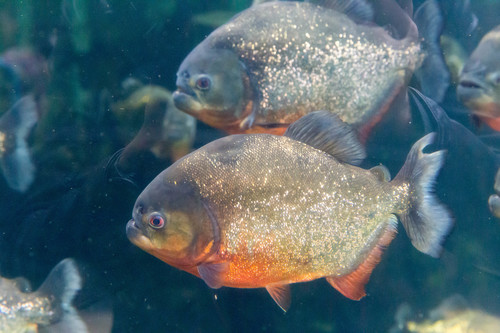
About Pygocentrus nattereri Kner, 1858
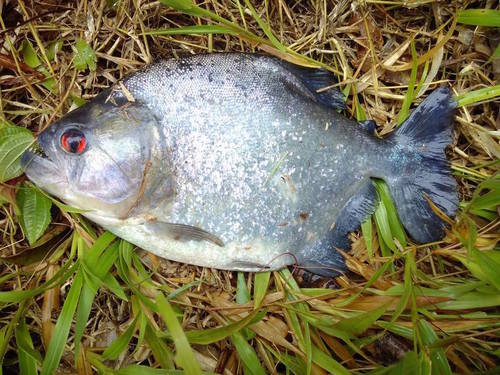
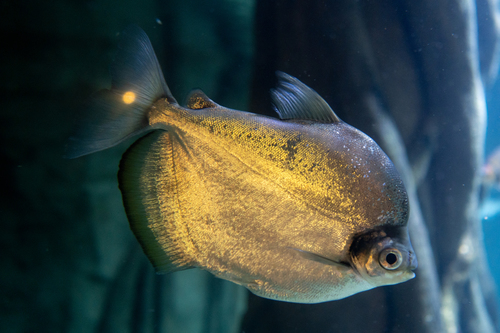
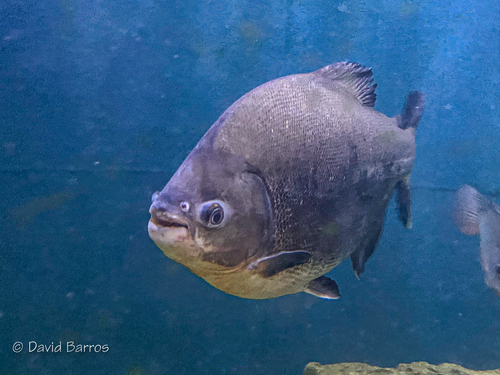
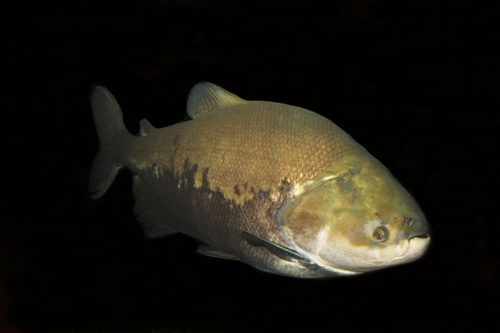
Pygocentrus nattereri, commonly called the red-bellied piranha, is widely known as a ferocious predator, even though it is primarily a scavenger. As the common name suggests, fully grown red-bellied piranhas have a reddish tint to their bellies, while juvenile fish are silver with darker spots. This species can reach a maximum weight of 3.9 kg (8 lb 10 oz) and a standard length of 50 cm (20 in), but individuals rarely grow longer than 35 cm (14 in). Most of the body is typically grey, with scales that carry silver flecks. Blackish spots sometimes appear behind the gills, and the base of the anal fin is usually black. The pectoral and pelvic fins range in color from red to orange. Females can be told apart from males by the slightly deeper red shade of their bellies. Red-bellied piranhas typically live in white water rivers, including those in the Amazon River Basin, as well as some streams and lakes. They can sometimes also be found in flooded forests, such as those in the Brazilian Amazon. They live in large groups called shoals, but they do not hunt in groups, though they will occasionally enter feeding frenzies. During a feeding frenzy, large groups of piranha will gather on a single large prey animal and consume it in just minutes. These attacks are extremely uncommon, and are triggered by provocation or starvation. Much of the common lore around the red-bellied piranha’s extreme ferocity originates from former United States President Theodore Roosevelt, after he completed the Roosevelt-Rondon Scientific Expedition. Roosevelt returned home with dramatic accounts of an entire cow being eaten down to the bones in just a few minutes. This event was later discovered to have been staged by local guides, who wanted to give Roosevelt a memorable journey spectacle. The guides had corralled and starved a group of piranhas for over a week in a section of the river, then drove the cow into that same section of the river for the display. There is no evidence that Roosevelt ever learned this staging had occurred. Red-bellied piranhas are widely distributed across the South American continent, found in Neotropical rivers in Argentina, Brazil, Bolivia, Colombia, Ecuador, Guyana, Paraguay, Peru, Uruguay, and Venezuela. They inhabit warm freshwater drainages of several major rivers including the Amazon, Paraguay, Paraná, and Essequibo, plus many smaller water systems. They can live in waters between 15 and 35 °C (59–95 °F), and can survive temperatures as low as 10 °C (50 °F) for short periods. While they are mainly found in whitewater, they have also been recorded living in blackwater and clearwater. Their habitats include major rivers, streams, lakes (including oxbow lakes and artificial dam-formed lakes), floodplains, and flooded forests. This species was introduced to China, likely through the aquarium trade, and was first detected there in 1990. It has since become an invasive species in China. No established populations of piranha, including the red-bellied piranha, are found in the United States. In 1998, one single red-bellied piranha specimen was found in a golf course lake in Simi Valley, Ventura County, California. The states of California and Washington prohibit possession of P. nattereri, and encourage active surveillance to stop the species from becoming established. Most of what is known about red-bellied piranha breeding comes from research on aquarium-held individuals, as most of their natural breeding habits remain understudied. Red-bellied piranhas are usually able to breed by the time they reach one year of age. Breeding occurs over a two-month period during the rainy season, though the exact timing varies by location. Most often, males build nests on newly submerged vegetation, and females lay around 5,000 eggs that stick to the surrounding plants. Males then fertilize the eggs. Eggs hatch after just two to three days. Juvenile piranhas hide among vegetation until they are large enough to defend themselves, at which point they begin seeking out small prey instead of hiding. Research on natural red-bellied piranha breeding behavior has identified specific behavioral patterns around nesting sites. Adult piranhas will swim side-by-side in small circles; sometimes two individuals will swim in opposite directions while keeping their bellies close to each other. While this behavior was initially thought to be a courtship display, closer observation shows the adults are actually defending their nesting sites. Nests are around 4 to 5 centimetres (1+1⁄2 to 2 in) deep, dug among water grasses, with eggs attached to the grasses and plant stems. Red-bellied piranhas form mating pairs, display nuptial swimming behavior, and guard nests, meaning the species provides parental care for both nests and young. If nests are left unguarded, other fish such as characids will prey on the eggs. Despite their defensive nest-circling behavior, red-bellied piranhas are often not aggressive toward other fish that approach their nests. It is possible that the presence of this predatory species alone creates enough of a threat to keep potential egg predators away from the nest. Some populations have two annual reproductive seasons, which are tied to water level fluctuations, the annual flooding pulse, water temperature, and other hydrological conditions. When red-bellied piranhas become sexually active, they lose their red belly coloration and choose spawning-friendly habitats such as flooded marginal grasses and vegetation within lakes. This differs from non-reproductive red-bellied piranhas, which prefer open water and areas under floating meadows.