About Pygathrix nigripes (A.Milne-Edwards, 1871)
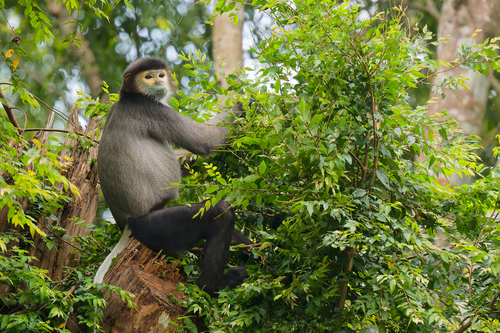
Like all species in the Pygathrix genus, the black-shanked douc (Pygathrix nigripes) is defined by its distinct coloration, and the colors of its head and neck set it apart from other Pygathrix species. Its most unique feature is a bluish face with large yellow eye-rings. It also has short, thin whiskers. A thin chestnut border outlines the face, and the back of the head is black. The region around the throat is white, the back is dark grey, and the belly is light grey. The rest of its body, including its legs and arms, is black, with the exception of a white pubic patch; the scrotum is blue and the penis is pink. While most individuals match this standard color pattern, a small number of genetically confirmed black-shanked doucs have been observed with color variations. In these variant individuals, the forearms are partially or completely white, and the lower legs are dark red. The cause of these variations is not fully understood, but one proposed explanation is hybridization between different douc species. The black-shanked douc has a tail that is equal in length to the combined length of its head and body. Only a small number of individuals have been measured to date. For males, the average head and body length is 50 cm (20 in), the average tail length is 69 cm (27 in), and the average weight is 5.3 kg (12 lb). For females, the average head and body length is 56 cm (22 in) and the average weight is 5.4 kg (12 lb). All Pygathrix species are endemic to Indochina, where the genus as a whole occurs in Cambodia, Laos, and Vietnam. However, the black-shanked douc is found only in Cambodia and Vietnam. Studies of douc species have found that each has a distinct ecological niche, with different species distributed across different latitudinal ranges spanning from north to south of Vietnam. The black-shanked douc occupies a narrow latitudinal range from 11° N to 13.5°N, in eastern Cambodia and southern Vietnam. It lives in multiple forest types: broad-leafed evergreen, semievergreen, mixed, and lowland dipterocarp forest. Most Pygathrix species are primarily found in the Annamite Range, a mountainous landscape in eastern Indochina. Like all douc species, the black-shanked douc is arboreal, and moves using quadrupedal locomotion and brachiation. It spends most of its time in the middle to upper forest canopy. It has been observed at elevations ranging from sea level to 1500 meters, but most low elevation forest has been cleared over time. As a result, most current sightings of the species occur at higher elevations.