About Pygathrix nemaeus (Linnaeus, 1771)
Like other doucs, the red-shanked douc (Pygathrix nemaeus) is a long, slender monkey. Males measure 55–82 cm (22–32 in) from head to body, with a 56–74 cm (22–29 in) tail, and weigh 8.6–11.4 kg (19–25 lb). Females measure 60–63 cm (24–25 in) from head to body, with a 44–60 cm (17–24 in) tail, and weigh 6.6–10.5 kg (15–23 lb).
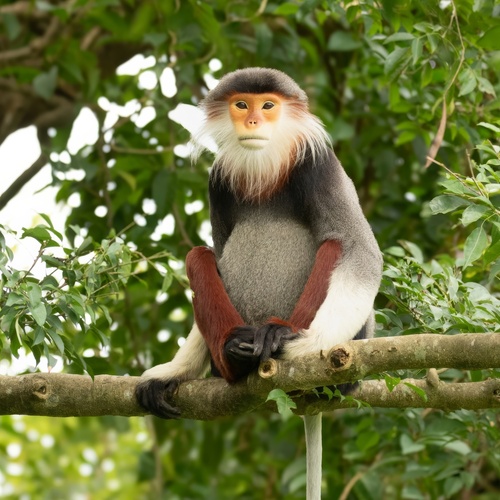
Red-shanked doucs are among the most colorful primates, and are nicknamed the "Queen of primates" for their one-of-a-kind appearance. They have agouti hair covering their crown, temples, inner thighs, ventral coat, nape of the neck, back, triceps, and the lateral sides of their arms. Their crown is silver, their temples are covered in red hair, and their foreheads are black. Adult males grow white whiskers roughly 12 cm long. Their eyes have a high axis, the fur on their cheeks and throat is white, their collar is orange with a black band stretching from one shoulder to the other, their face is yellow-brown, and they have light blue eyelids. Their inner arms as well as their inner, lateral, and back thighs are black, while their lower legs are a vibrant red. Their abdomen and back are silver, their sacral area is white, and both their hands and feet are black, as are their nipples. Their tails are white, and are often around the same length as their combined head and body length. Their coloration becomes less vibrant, and their red patches smaller, at more southern latitudes; in Laos's Nam Ghong Provincial Protected Area, red-shanked doucs only have small red patches around their ankles.
Red-shanked doucs show minor sexual dimorphism in body size, but not in coloration. There is a small difference in rump markings between the sexes: males have round white spots above the white triangle on their rump, which females lack. Males of all ages have a white spot on both sides of the corners of the rump patch, plus red and white genitals.
This species is native to Indochina: Vietnam, southern Laos, and possibly northeastern Cambodia, all east of the Mekong River. It is the only douc species that occurs across all three Indochinese countries, and was completely unstudied before 1967. In Laos, red-shanked doucs range from the southern Nam Ghong Provincial Protected Area to the north-central part of the country. Laos is thought to host the largest global population of red-shanked doucs. Central Laos's Nakai-Nam Theun National Protected Area holds the most individuals, at approximately 4,420 groups, followed by Hin Namno National Protected Area. In Vietnam, the species lives between Nghệ An and Gia Lai provinces, between 18°29'N and 14°21'N. Sơn Trà Nature Reserve on Sơn Trà Mountain in central Vietnam holds Vietnam's largest population, at approximately 700–1300 individuals. Phong Nha – Kẻ Bàng National Park is also an important site for the species in Vietnam. A single observation of red-shanked doucs in Cambodia's Ratanakiri Province, on the Vietnam border, was recorded by Rawson and Ross in 2008. There is an unconfirmed report of a red-shanked douc specimen from Hainan, China: the specimen was given to the Staatliches Museum by Dresden Zoological Garden, which claimed it originated from Hainan, but the original zoo records no longer exist, so this origin remains unconfirmed.
Red-shanked doucs inhabit evergreen, semi-evergreen, and occasionally limestone forests, at elevations up to 1,600 metres (5,200 ft). They are arboreal, and spend most of their time in the forest canopy, including to sleep. They occasionally descend to the ground to drink water or eat mineral-rich dirt. Ecological niche modeling predicts the species can live between roughly 14°N to 21°N. Their total home range averages around 36 hectares (89 acres), with a core area of 8 hectares (20 acres). Their home range shrinks to 24 hectares (59 acres) in the dry season, and expands to 33 hectares (82 acres) in the wet season. There are weak correlations between precipitation, temperature, and diet and home range size, but these correlations are not strong enough to draw firm conclusions.