About Pycnoporellus alboluteus (Ellis & Everh.) Kotl. & Pouzar
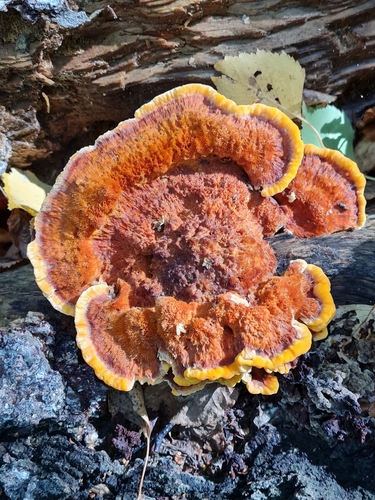
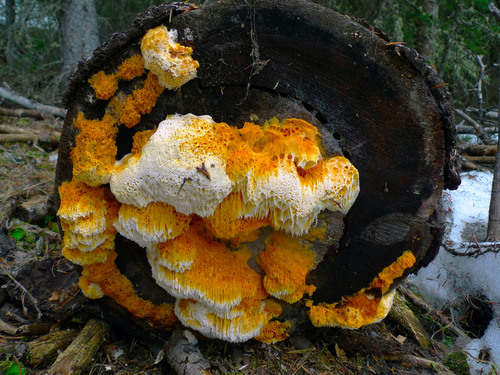
Pycnoporellus alboluteus produces annual, resupinate fruit bodies that can spread across substrate surfaces up to 1 meter (3 ½ feet) across. When fresh, the fruit bodies are bright orange, finely grooved, and have a soft, spongy upper surface. The pore surface is orange, with angular pores usually over 1 mm in diameter. Thin pore partitions split to form a teeth-like layer. The flesh is soft, pale orange, felt-textured, and up to 2 mm thick. Tubes match the pore color, are continuous with the flesh, and reach up to 2 cm (¾ inch) thick. Bruised pores sometimes turn black. All tissues of the fungus turn bright red when a drop of dilute potassium hydroxide is applied. Fresh fruit bodies hold a large amount of moisture, and can be squeezed to release liquid like a sponge. The entire fruit body can be easily removed in large sheets from the wood it grows on. The edibility of this fungus is unknown, and it has a fragrant odor. Spores are white in spore deposit. Individual spores are cylindrical, smooth, hyaline (translucent), inamyloid, and measure 9–12 by 3–3.5 μm. Pycnoporellus alboluteus has a monomitic hyphal system, meaning it is constructed only of generative hyphae, which are thin-walled, branched, and narrow. Hyphae in the flesh layer are thin- to thick-walled, frequently branched, and 2–10 μm in diameter; hyphae from the pores have roughly similar morphology, but measure 3–5 μm in diameter. Both types of hyphae have a thin incrustation on their walls that gives them a rough appearance when viewed under a light microscope. The hymenium (spore-bearing tissue layer) is 40–60 μm thick, and contains abundant cystidia that are hyaline, 7–9 μm in diameter. Cystidia are cylindrical, thin-walled to moderately thick-walled, hyaline, have a septum at their base, and measure 60–120 by 5–10 μm. The spore-bearing basidia are club-shaped, four-spored, and measure 25–35 by 6–7 μm. Ecologically, Pycnoporellus alboluteus causes brown cubical rot on fallen coniferous tree logs. Fruit bodies usually grow on the underside of logs, and can begin developing while still surrounded by snow. While new fruit bodies typically start growing in spring, they can persist year-round. In Europe, it usually grows on Picea species, and also occurs on Abies. In North America, it also grows on Populus. This fungus has a circumpolar distribution, and is found in the boreal conifer zone, particularly in the montane zone at 2,400–3,000 m (8,000–10,000 ft). In North America, fruit bodies begin growing under snow in spring and continue until midsummer, while in Europe the fungus is most often encountered in autumn. It is abundant in the Rocky Mountain region of North America, but rare in eastern United States and Canada. As a high-altitude timberline fungus, its fruit bodies are exposed to bright light, high winds, and low relative humidity, all of which promote drying. The fungus counteracts these harsh conditions by absorbing water quickly and drying slowly. In Europe, it is one of 32 threatened species proposed for protection under the Bern Convention. It has been recorded from Czechoslovakia and Poland, where it is mostly found in old-growth forests. It is rare in northern Europe, where it has been found growing on Picea abies and Alnus incana in Finland, and also occurs in Sweden. In North America, the fruit bodies of this fungus are a food source for the rove beetle Scaphisoma castaneum, the pleasing fungus beetle Dacne cyclochilus, and multiple minute tree-fungus beetles including Octotemnus laevis.