About Pycnopodia helianthoides (Brandt, 1835)
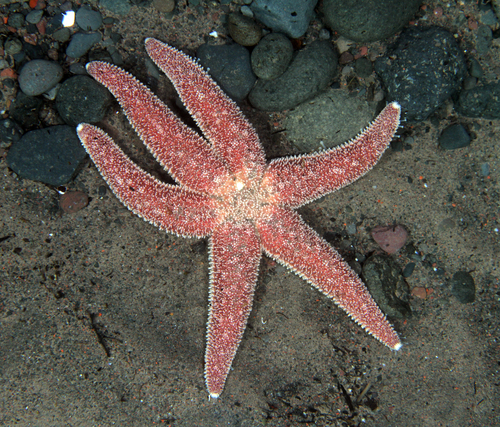
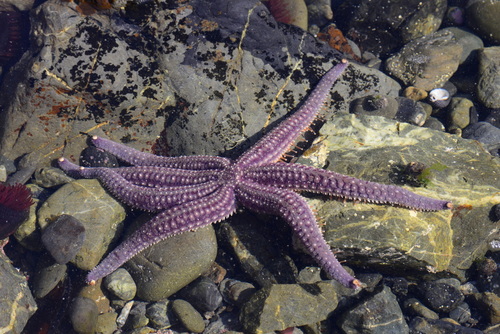
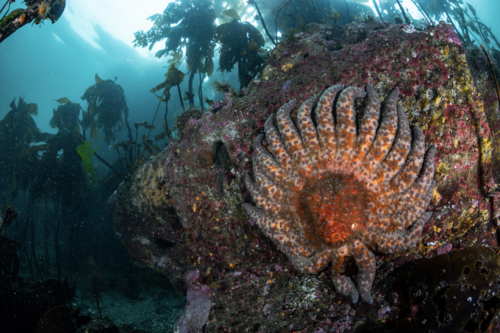
Pycnopodia helianthoides, commonly known as the sunflower sea star, can reach an arm span of 1 m (3.3 ft). It is the heaviest known sea star, weighing approximately 5 kg. It is the second largest sea star in the world; only the little-known deep-water species Midgardia xandaros is larger, reaching an arm span of 134 cm (53 in) with a body roughly 2.6 cm (1 inch) wide. Growth of the sunflower sea star is rapid early in life, and slows as the animal ages. Researchers estimate a growth rate of 8 cm (3.1 in) per year in the first several years of life, dropping to 2.5 cm (0.98 in) per year later in life. This species' color ranges from bright orange, yellow-red to brown, and is sometimes purple. It has soft, velvet-textured bodies, and between 5 and 24 arms that each have powerful suckers. Most sea star species have a mesh-like skeleton that protects their internal organs. Sunflower sea stars were once common in the northeast Pacific from Alaska to southern California, and were a dominant species in Puget Sound, British Columbia, northern California, and southern Alaska. Between 2013 and 2015, the population declined rapidly due to sea star wasting disease and warmer water temperatures caused by global climate change. The species disappeared from its habitats off the coast of California and Oregon, and its population was reduced by 99.2% in waters near Washington. Ecologists conducting shallow-water observations and deep offshore trawl surveys found that between 2004 and 2017, the mean biomass of sunflower sea stars declined 80 to 100%. In 2020, the species was declared critically endangered by the International Union for Conservation of Nature. Sea star wasting disease is now known to be caused by the bacterial pathogen Vibrio pectenicida, which also infects scallops. Sunflower sea stars generally inhabit low subtidal and intertidal areas up to 435 meters deep, located in areas with substrates rich in seaweed, kelp, sand, mud, shells, gravel, or rocky bottoms. They do not enter high- and mid-tide areas because their heavy body structure requires water to support it. Sunflower sea stars can reproduce sexually via broadcast spawning, and have separate male and female individuals. They breed from May through June. To prepare for spawning, individuals arch up using around a dozen arms to lift their fleshy central mass above the seafloor, then release gametes into the water for external fertilization. The resulting larvae float and feed near the water surface for two to ten weeks. After this planktonic larval period, the larvae settle to the seafloor and mature into juveniles. Juvenile sunflower sea stars start life with five arms, growing additional arms as they mature. Most sunflower sea stars have a lifespan of three to five years.