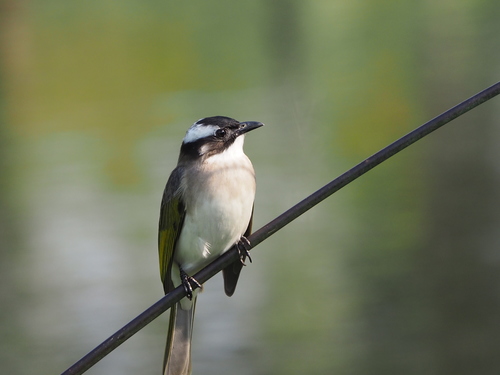
About Pycnonotus sinensis (Gmelin, 1789)
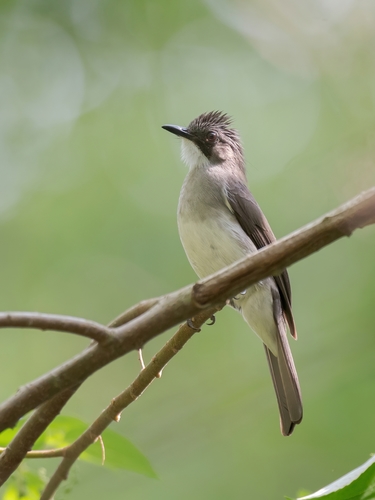
The light-vented bulbul (scientific name Pycnonotus sinensis (Gmelin, 1789)) measures approximately 19 cm (7.5 in) in length. It has a black crown and moustachial stripe, with white patches covering the nape and the sides of its black head. White plumage extends from its eyes to the back of its head. Its upperparts are greyish-brown mixed with olive, while its wings and tail are brown and fringed with bright olive. Its underparts are whitish, marked with a pale brown breastband. This species is noisy, and sings with a very bright, varied song that sounds like cha-ko-lee...cha-ko-lee....
This bulbul is found in China (including Hong Kong and Macao), Japan’s Nansei Islands, Laos, rare occurrences in North Korea and South Korea, Taiwan, Thailand, and Vietnam. In Hong Kong, the light-vented bulbul is abundant in lightly wooded areas, cultivated land, and shrubland, while the red-whiskered bulbul is the common bulbul found in suburbs and urban parks. In Taiwan, by contrast, the light-vented bulbul dominates all these same habitats, though it is replaced along the east coast by Styan's bulbul. Chinese bulbuls (light-vented bulbuls) are seen frequently in Shanghai, where it is perhaps the third most common bird, after tree sparrows and spotted doves.