About Pycnonotus luteolus (Lesson, 1841)
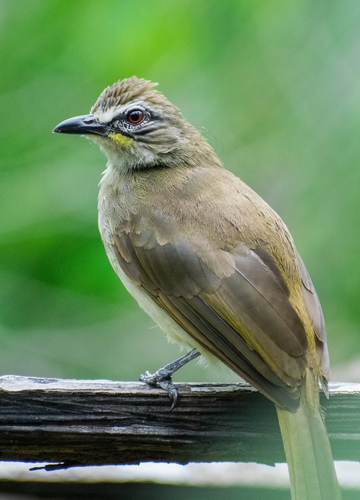
The white-browed bulbul, scientific name Pycnonotus luteolus (Lesson, 1841), reaches about 20 cm (7.9 in) in total length, with a moderately long tail measuring 8 centimetres (3 inches). It has olive-grey plumage on its upperparts and whitish plumage on its underparts. This species can be identified by its white supercilium, a white crescent below the eye, and a dark eyestripe and moustachial stripe. Its vent is yellowish, and there is some yellow marking on the chin and moustache area. Unlike the similar-looking and similar-sounding yellow-throated bulbul, which lives in rockier habitats, the white-browed bulbul has a largely whitish throat. Three or four hair-like filoplumes are present on the nape of the neck. Males and females have identical plumage. This bird is usually first noticed by a burst of song it sings from the top of a bush; it often dives into dense bush after singing, making it hard to spot. Its song is a rich, spluttering warble, and the species is more often heard than seen. The subspecies P. l. insulae is slightly darker in plumage and has a shorter wing than the nominate subspecies. This species is endemic to southern India and Sri Lanka. Its northern range boundary runs across Gujarat, Madhya Pradesh, and western West Bengal, near Midnapur. It inhabits dry open scrubland mainly on plains, and can also be found in gardens and woodlands with dense shrubbery. White-browed bulbuls are usually seen alone or in pairs. They forage within bushes for fruit, nectar, and insects. Their breeding season extends from March to September, and they may potentially breed twice a year. Breeding peaks occur in February and September, and the dry season from May to July is typically avoided for breeding in the Point Calimere region. They build a loose cup-shaped nest from twigs, cobwebs, and hair, placed low down in a thick bush, usually on the bush's periphery. A typical clutch contains two eggs. Individual white-browed bulbuls may live for more than 11 years.