About Pycnonotus jocosus (Linnaeus, 1758)
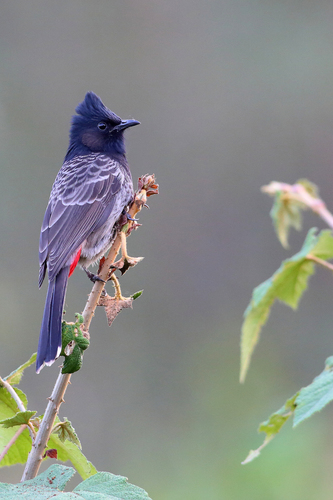
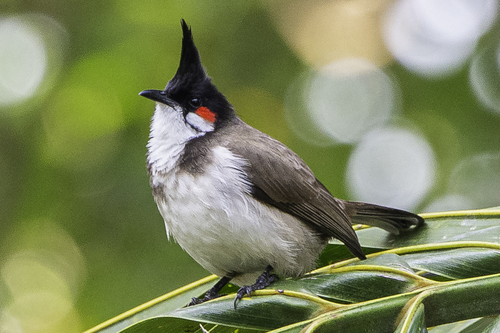
The red-whiskered bulbul, with the scientific name Pycnonotus jocosus (Linnaeus, 1758), reaches approximately 20 centimetres (7.9 in) in length. It has brown upperparts, whitish underparts with buff flanks, and a dark marking that extends onto the breast at shoulder level. Key identifying features include a tall pointed black crest, a red face patch, a thin black moustachial line, a long brown tail with white tips on the terminal feathers, and a red vent area. Juveniles do not have the red patch behind the eye, and their vent area is rufous-orange. An albino individual of this species has also been recorded. Its loud, distinctive call is a sharp kink-a-joo, which has also been transcribed as pettigrew, kick-pettigrew, or pleased to meet you, while its song is a scolding chatter. This species is more often heard than seen, but individuals will often perch conspicuously, particularly in the mornings when they call from the tops of trees. The lifespan of red-whiskered bulbuls in captivity is approximately 11 years. This species lives in lightly wooded areas, more open country with bushes and shrubs, and farmland. Irruptions of large flocks have been recorded since early times; Thomas C. Jerdon noted that the species "periodically visiting Madras and other wooded towns in large flocks." It has established introduced populations in Australia, Los Angeles, Hawaii, and Florida in the United States, as well as Mauritius, Assumption Island, and the Mascarene Islands. In Florida, it only occurs in a small area, and its population could be easily extirpated. It was completely removed from Assumption Island between 2013 and 2015 to prevent it from colonizing nearby Aldabra, the largest tropical island that remains free of introduced birds. The red-whiskered bulbul was introduced to Sydney in 1880 by the Zoological and Acclimatization Society, became well established across Sydney's suburbs by 1920, and continued to spread slowly to areas around 100 km away. It is now also found in suburban Melbourne and Adelaide, though the route of its arrival there is not clear. On the island of Réunion, where this species has become established, it helps spread alien plant species such as Rubus alceifolius. In Florida, red-whiskered bulbuls feed on the fruits and berries of up to 24 different exotic plants, including loquat (Eriobotrya japonica), Lantana spp., Brazilian pepper (Schinus terebinthifolius) and figs (Ficus). In Mauritius, they help disperse the seeds of Ligustrum robustum and Clidemia hirta. Seeds that pass through the gut of red-whiskered bulbuls germinate better than seeds that do not. Populations of the species on Réunion have diversified over 30 years, and show visible differences in bill morphology that correspond to the food resources they have adapted to use. The red-whiskered bulbul feeds on fruits, including the fruits of the yellow oleander which are toxic to mammals, as well as nectar and insects.